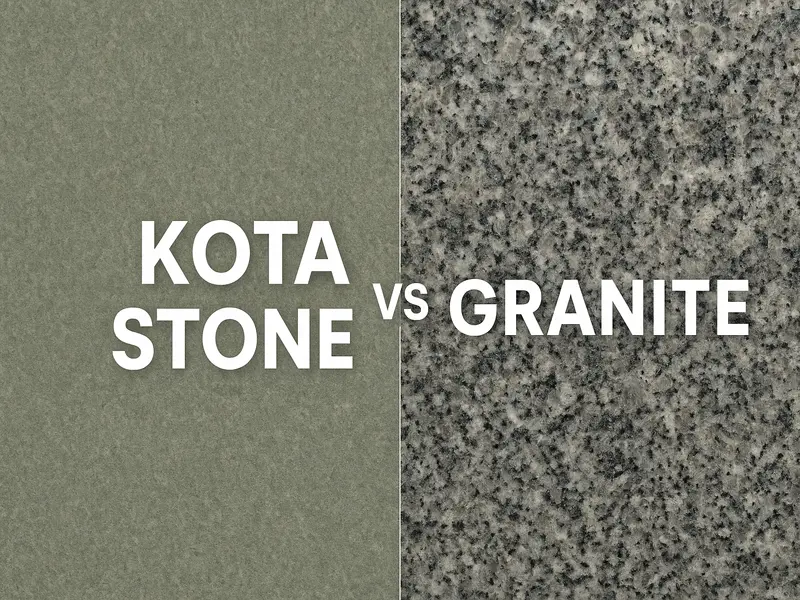
Cristallo Quartzite is one of the unique and rarest natural stones in the world.
A translucent, crystal-rich quartzite, it is quarried from a small number of reserves in Brazil and India. When light passes through it, the stone glows from within. When polished, it catches the room. It's the kind of material that doesn't decorate a space — it defines one.
For architects and designers working at the highest level, Cristallo has become a quiet signature. You'll find it in the show kitchens of homes that take a decade to build, in the spa walls of hotels that stay full a year ahead, in the lobbies of buildings that don't need to announce themselves. It's chosen by people who understand that some surfaces are not finishes, but foundations of how a space feels.
We'll cover what Cristallo actually is, what it isn't, where it comes from, what makes it harder to fabricate than any other quartzite, how to read a slab when you're standing in front of one, and what separates a true Cristallo from the many stones now being sold under its name.
It's written by a stone manufacturer in Rajasthan, India — at the source. We work with these slabs. What follows is what we know.
What Is Cristallo Quartzite, Actually?
To understand Cristallo, you have to start with what quartzite is — and to understand that, you have to start with sand.
Quartz (the mineral that makes up most sand particles) is one of the most common minerals on Earth. Chemically, it's silicon dioxide (SiO₂). It's hard (Mohs 7, harder than glass), and it doesn't break down easily, which is why quartz grains end up everywhere — in beach sand, in deserts, in ancient seabeds.
Over millions of years, those quartz grains accumulate, get buried under more layers, and become cemented together by water and minerals. The result is sandstone — a sedimentary rock made of compacted, cemented quartz grains.
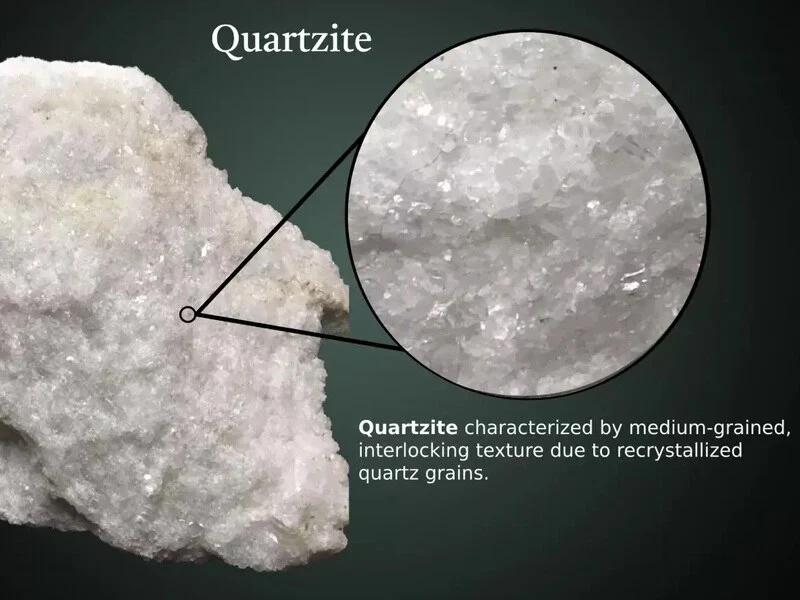
Then comes the transformation. Millions of years ago, that sandstone got buried under weight, heat, and pressure — geological forces from tectonic activity. The quartz grains didn't just stay glued together anymore. They physically fused with each other. The grain boundaries dissolved, and the quartz recrystallised into a new, interlocked structure.
The result is quartzite. Not grains held together by cement — but a continuous, fused crystal network. It's not assembled. It's one piece.
Cristallo is a quartzite — but not just any quartzite. Cristallo Quartzite is one of a small handful of natural stones that combine extreme hardness with translucent, light-transmitting beauty.
What makes Cristallo specifically remarkable is two things: its silica content and its crystal structure.
True Cristallo typically tests at 95% silica or higher — comfortably above the 90% threshold required for any stone to be classified as quartzite. The remaining 5% consists of trace minerals — iron oxide, mica, feldspar, and others — which give Cristallo its veining, undertones, and rare colour variants. We'll get to those (Cristallo Gold, Rose, Blue, Rosso, and others) later in this article.
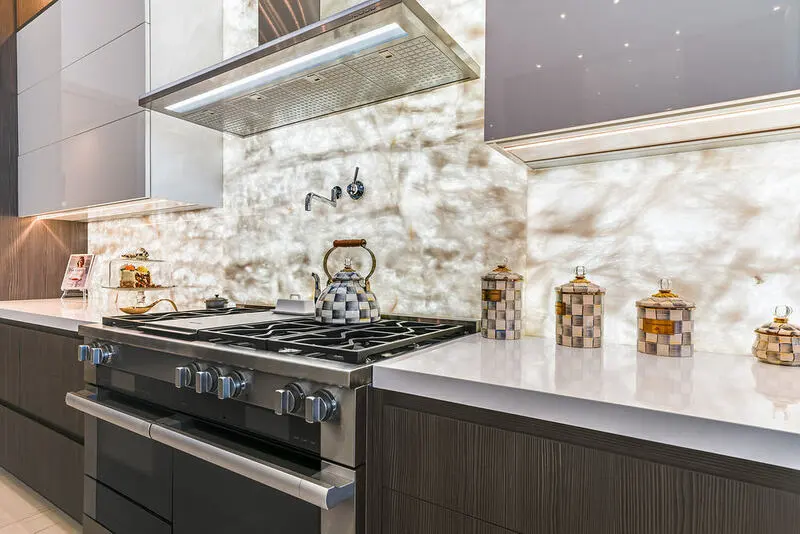
The crystal structure is where Cristallo earns its name — and its price. The quartz crystals in Cristallo are unusually large, well-formed, and tightly aligned. Light passes through them. That's why Cristallo glows when it's backlit. No marble can do this. No granite can do this. Engineered quartz, despite the misleading name, can't do this either.
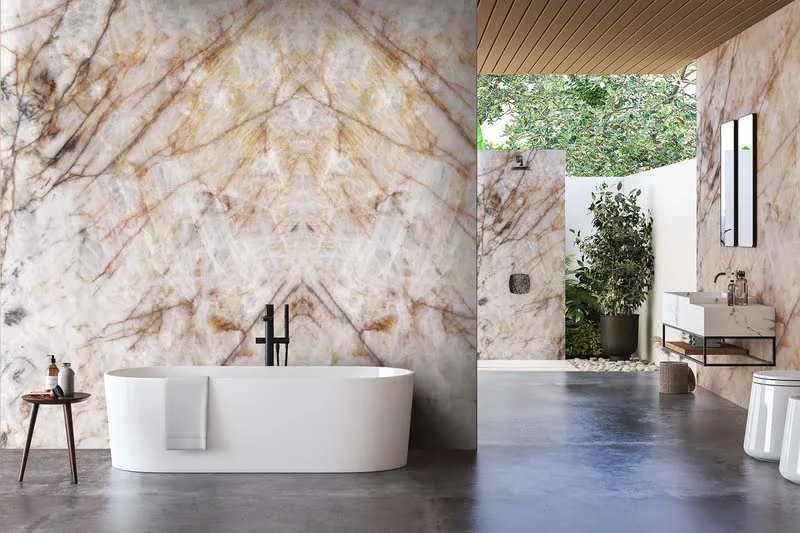
Cristallo Is Not Marble, Not Granite, Not Engineered Quartz
Before we move forward — let's clear up the single biggest source of confusion buyers face. Stone Galleria comes across many enquiries asking for "cristallo marble," "cristallo granite," and "cristallo quartz”.
But here's the simple truth: none of those names actually exist. There is no Cristallo Marble. There is no Cristallo Granite. There is no Cristallo Quartz. Cristallo is a quartzite. That's the only natural stone category it belongs to.
People ask for "Cristallo Marble" because Cristallo looks like a marble — soft white background, gentle veining, an elegant feel. But Cristallo behaves nothing like marble. Marble scratches, etches, and stains. Cristallo is harder than glass and immune to household acids.
People seek "Cristallo Granite" because granite is the other category of hard natural stone most buyers know. But Cristallo isn't a granite — granite is an igneous rock with a speckled, grainy appearance, while Cristallo is a metamorphic rock with a crystalline, translucent character. Different formation. Different look. Different performance.
People assume "Cristallo Quartz" — and this is the most expensive confusion to get wrong. "Quartz" in the stone trade refers to engineered quartz: man-made slabs like Caesarstone, Silestone, or Quartzforms, made from crushed quartz mixed with resins and pressed in a factory.
Marble has the beauty. Granite has the hardness. Engineered quartz has the consistency. Cristallo has all three at once — which is why it commands the prices it does, and why it gets imitated as often as it does.
ALSO READ | Quartz vs Quartzite: What’s the Difference in Cost, Durability & Applications
Where Does the Name "Cristallo" Come From?
The name is Italian for "crystal" — from the Latin crystallus and Greek krystallos, meaning “ice.”
Italy has shaped the global vocabulary of stone for centuries. Most names you see in showrooms — Calacatta, Statuario, Travertino, Bardiglio, Rosso Levanto — are Italian. Cristallo fits that pattern.
Still have questions about Cristallo Quartzite?
If you're trying to understand how Cristallo differs from other stones — or whether it is the right fit for your project — feel free to reach out. We will share clear, practical inputs based on actual slabs.
Ask Us a QuestionThe name describes what you see. When polished, the stone looks like a slab cut from a single crystal — clear, glassy, almost luminous. There was really no other word for it.
Where Cristallo Comes From: Brazil and the Rise of India
For most of its history, Cristallo Quartzite came from one country.
Brazil — particularly Bahia, Espírito Santo, and Minas Gerais — was the world's source. When architects said "Cristallo," they meant Brazilian Cristallo.
That changed in the last few years.
Today, Rajasthan, India is also actively quarrying Cristallo quartzite deposits. Few things made this possible, mostly post-pandemic:
- Investment in modern imported processing machinery.
- Improved quarrying technology and at mine facilities like vacuum-assisted block reinforcement.
- Global demand outpacing Brazilian supply.
India is now becoming a global source of Cristallo — at par with Brazilian. The clearest proof: in 2025, the Natural Stone Institute named Crystallo Rare its Stone of the Year. A buyer should choose based on what the project needs — not on a default assumption that one origin is better.
How to Read a Cristallo Slab When You're Standing in Front of One
A photograph cannot tell you what a Cristallo slab is. Neither can a brochure, a price list, or a detailed description. The slab itself, in person, is the best source of information.
Any quartzite must contain at least 90% silica. Typical Cristallo tests at 95%, with the remaining 5% made up of trace minerals — mica, feldspar, iron oxide. The very best Cristallo can tests at 99% or higher, with almost no visible mineral traces. The moment you see feldspar — in white, gold, pink, or any other colour — the slab is no longer true Cristallo. It's usually classified as Patagonia, a related but distinct quartzite.
Stand back and look at the slab as a composition. Does the pattern flow naturally, or does it stop abruptly at points? Is the veining concentrated in one half and absent from the other? What's the colour of the veining — grey, gold, smoky brown — and does it support the room's palette or fight with it?
Run your hand across the surface. A polished Cristallo should feel like glass. Fissures are natural to this stone; they exist in nearly every slab to some degree. What you're checking is whether the slab has been well-processed — minimal fissures, cleanly handled, free of large resin patches. Some resin is normal. Excessive resin is a warning.
Backlight it — or ask for a video. If the stone yard has a backlight rig, use it. If not, ask for images and a backlit video. Any Cristallo seller has this on hand as standard practice.
The Cristallo Colour Family
Most people know Cristallo as the white natural stone. That's still its primary form — but Cristallo isn't only white.
The same crystalline quartzite, when it forms with different trace minerals, produces a range of colours and tones. Iron oxide brings out gold and rose. Copper and other minerals can introduce blue and green tints. Higher concentrations of these inclusions produce the different colour variants.
Distinct Variants
A few naturally coloured Cristallos are widely recognised in the trade as separate categories:
- Cristallo White (or Bianco Cristallo). The classic. Pure white background, restrained grey or smoky veining, the standard form against which everything else is measured.
- Cristallo Gold. Warm gold and amber tones running through the white background, caused by iron oxide inclusions. Particularly striking when backlit, where the gold deepens and warms.
- Cristallo Rose (also Rosa, Pink). Soft pink to rose-blush tones across the white field, again from iron oxide but in a different concentration and form.
- Cristallo Blue. Pale blue to blue-grey hues, the result of trace mineral inclusions.
- Cristallo Rosso. Deep red to russet tones.
Beyond these core variants, you'll see many other "Cristallo" names in the market — Cristallo Tiffany, Cristallo Lumix, Cristallo Extra, Cristallo Supreme, Cristallo Wind, Cristallo Traslux, Crystallo Rare, and others.
Some of these reflect real differences in crystal structure or vein pattern. Others are commercial names — applied by traders, importers, or showrooms to differentiate slabs that may otherwise look very similar.
Comparing Cristallo vs. Taj Mahal Quartzite
When buyers narrow the choice down to "best white quartzite," it usually comes down to Cristallo or Taj Mahal. Both are legitimate. Both are durable. Both are beautiful. They serve different design intentions.
Cristallo reads cool. The background is whiter, the veining is restrained or smoky, and the stone transmits light. It's the choice for modern interiors and for any project where backlighting is part of the design.
Taj Mahal reads warm. The background is creamy or beige, the veining flows in golden tones, and the overall effect is softer. It's the choice for transitional and classical interiors, and where backlighting isn't a factor.
Both resist etching and acids. Cristallo is rarer, harder, more translucent — and typically priced higher. Taj Mahal is more broadly available and a step easier to fabricate.
Neither is "better." They are different stones for different rooms.
| Feature | Cristallo Quartzite | Taj Mahal Quartzite |
| Visual Impact | Luminous, crystal-clear brilliance | Subtle, creamy elegance |
| Lighting Effects | Stunning when backlit | Gentle underlighting possible |
| Resilience | Ultra-dense, etch & stain-resistant | Equally durable |
| Investment Level | Prestige-priced, rare | Premium, more broadly accessible |
| Aesthetic Prestige | Pinnacle of opulence | Enduring sophistication |
| Exclusivity | Strictly limited availability | Select, but more common |
Need help with Cristallo Quartzite?
If you have a requirement or want to check availability, you can get in touch with us. We will share details based on actual slabs and current factory pricing.
Contact UsThe choice is not about “better” or “worse”—it’s about your vision for luxury, legacy, and the statement you want your space to make.
Backlit Cristallo Quartzite: How It Works and What Goes Wrong
Cristallo is one of a small handful of natural stones that genuinely transmit light — alongside select onyx and the rarest white marbles. But it's the only one of those stones hard enough to function as a working countertop. Onyx scratches under a knife. Marble etches under lemon. Cristallo quartzite doesn't. That's why "backlit Cristallo countertops" has become a category of its own.
How It Works
Cristallo's quartz crystals are unusually large and tightly aligned. Place an LED panel behind the slab and light travels through the crystal lattice, diffusing across the surface. The slab becomes the light source. Glow quality depends on slab translucency, thickness (2 cm works better than 3 cm), and the LED panel itself.
What Goes Wrong
Backlit Cristallo requires two separate skills, and most failures come from missing one.
- Fabrication. Cristallo is hard but brittle. Edges are visible from below as well as above, and any internal fractures show under light. A seasoned Cristallo fabricator knows which slabs can take the cuts.
- Lighting. The panel has to be evenly distributed, colour-matched to the stone, sealed against moisture, and serviceable when the LEDs eventually fail. A general lighting installer doesn't automatically know this work.
Done well, backlit Cristallo is one of the most striking elements you can put into a space.
ALSO READ | Translucent Stone Slabs: Backlit Stone in Architectural & Interior Design
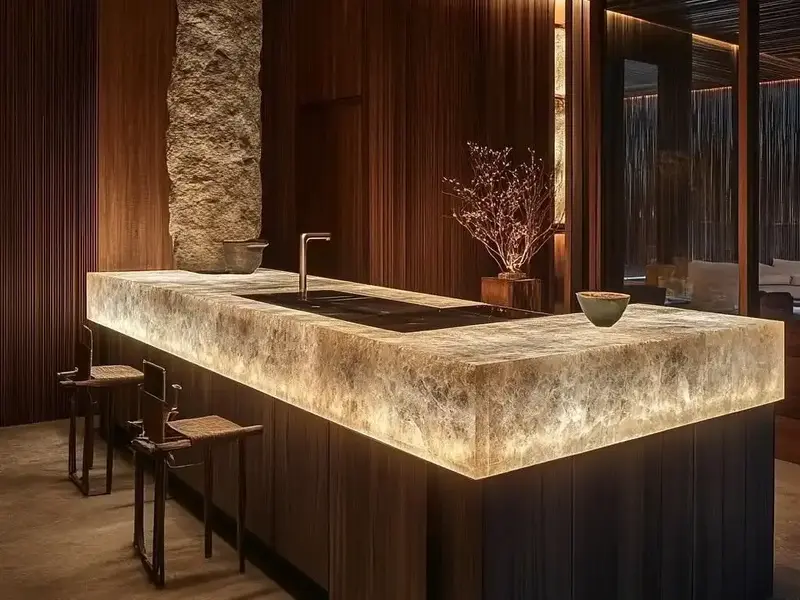
Cristallo Quartzite Price: What You'll Actually Pay at the Factory
If you're curious to know how much Cristallo Quartzite costs per square foot, the most useful place to start is the factory level.
At Stone Galleria in Rajasthan, India, we work directly with blocks and slabs. This allows us to share a clear view of what Cristallo costs at factory gate.
By the time the same slab reaches retail markets across the world — Mumbai, Dubai, or California — the price can change significantly due to logistics, fabrication, and multiple layers in the supply chain.
What we can do is show you where the price actually starts.
Factory Gate Price
At Stone Galleria, factory-gate pricing for Cristallo Quartzite typically falls in the range of ₹800 to ₹3,500 per square foot. That's roughly $10 to $40 per square foot at current exchange rates.
That's a wide range — and intentionally so. Cristallo isn't one stone with one price.
The next section breaks down exactly what causes this variation.
What Drives the Price Range of Cristallo Quartzite?
Most pricing factors for natural stone are universal — size, thickness, finish, location of the buyer. Those apply to every quartzite, every marble, every granite on Earth. We won't repeat them here.
What we will cover are the factors that move Cristallo's price specifically — the ones that separate one Cristallo slab from another, and one Cristallo project from another.
- Silica content. The defining number. The higher above 90%, the rarer and more valuable the slab. This is also what makes the difference between true Cristallo and softer stones being sold under the name.
- Crystal size and quality. Cristallo earns its name from its crystals. Larger, well-formed, tightly aligned crystals create the translucency that makes the stone glow when backlit. Smaller, less defined crystals do not.
- Veining and pattern. A clean white background with restrained veining sits at one price. A bold Cristallo Gold, a rare Cristallo Rose, or a slab with exceptional bookmatch potential sits at another.
- Whiteness. Within white Cristallo specifically, the purer and brighter the background, the higher the price. Subtle yellowing or grey tones from trace minerals shift the value down — even if the slab is otherwise excellent.
- Fragility. Cristallo is hard but fragile. Both things are true. A slab that survives extraction, cutting, and transport without resin reinforcement or hairline fractures is worth significantly more than one that needs repair.
- Fractures, fissures, and cracks. These exist in nearly every Cristallo slab to some degree. The question is how visible they are, where they sit, and whether they affect structural integrity. Cleaner slabs, in this sense, are rarer — and priced accordingly.
- Processing level. A raw block, a sawn slab, a polished slab, and a fully fabricated piece are four very different products. Each step adds cost, but it also adds value — and it shifts who in the chain is doing the work.
- Origin. Cristallo from Brazil and Cristallo from Rajasthan are both legitimate, but they don't sit at identical prices. The block, the quarry, even the seam within the quarry can change the value of an otherwise similar-looking slab.
These are the factors that genuinely determine Cristallo's price. The generic factors — size, thickness, finish — apply on top of these, but they aren't the heart of the question.
What the Factory Price Doesn't Include
The factory price is for the slab. Getting that slab to your project is a separate set of costs — transport, fabrication, edges, sealing, installation, and a breakage allowance most first-time buyers forget to plan for. Add a retailer's or fabricator's margin on top of all that, and the final installed price can be three to five times the factory cost.
We're not saying that's wrong. Each link in the chain adds real value and real cost. We're saying: as a buyer, you should know where every rupee of your final price is going.
What Cristallo Owners Actually Say
The most useful information about living with Cristallo doesn't come from articles — it comes from people who've installed it and lived with it.
Two patterns show up consistently in discussions on Houzz and Reddit, where homeowners and fabricators discuss real projects.
The first is performance. Owners describe Cristallo as a step-change after years of dealing with marble — no etching from wine or lemon, no scratches from knives, no staining from oil. One Houzz commenter, an owner in Orlando, put it directly: "Cristallo is a superb stone... so hard it won't even absorb a sealer. Much better than marble since [it] won't etch or stain or scratch."
The second is fabrication. The same conversations consistently come back to the same warning: get a fabricator who has worked with Cristallo specifically. Diamond-tipped water-jet equipment. Real experience. The wrong fabricator turns a great stone into a cracked one.
These match what we see at the factory side every day. The stone delivers — when the people working with it know what they're doing.
Conclusion
Cristallo is one of the rarest natural stones in the world. It is also one of the easiest to get wrong — through poor selection, mis-labelling, inexperienced fabrication, or simply not knowing what to ask for.
If you're considering Cristallo for a project, the most useful thing we can offer is this: the stone rewards the buyer who takes their time. Visit the factory or yard. Look at the slab in person. Ask right questions. Hire a fabricator who has worked with Cristallo specifically, not just with quartzite generally. Allow for breakage. Plan for backlighting from day one if you want it.
Done with care, Cristallo will outlast the building it's installed in. Done in haste, it becomes the most expensive mistake in a project full of them.
Either way, the choice is yours. We've tried to give you everything you need to make it well.