If you are choosing stone for a terrace, a driveway or the surround of a pool, someone has probably told you that granite handles heat well. In one sense that is true. Granite does not crack, fade or fall apart in the sun the way cheaper surfaces do.
But surviving heat and being pleasant to stand on are two different things, and the second one is where dark stone runs into trouble. This article is about what actually happens to a dark slab in strong sun, how hot it gets, and the two or three questions that will tell you whether the stone in front of you is right for the place you want to put it.
Every number here comes from published research or a standard, and the sources are listed at the end so you can check any of them.
The short version
- Colour matters far more than the type of rock. A dark slab is hot because it is dark, not because it is granite.
- Dark paving in open sun can reach temperatures that burn skin in about a minute.
- Shade makes a bigger difference than any change of colour.
- Most black stone sold as granite is not, geologically, granite at all.
- There is a proper test for this. Ask for the number.
Does Black Granite Get Hot in the Sun?
Yes, everything you put outdoors absorbs some sunlight and bounces the rest back. The share it bounces back is called solar reflectance, and it runs from 0 to 1. A high number means a cool surface. A low number means the sunlight is going into the stone and coming back out as heat.
The Lawrence Berkeley National Laboratory measured a black-and-red granite at 0.19. Dark red basalt came out slightly lower at 0.17. For comparison, the same instrument read a white feldspar at 0.49 and white cement at 0.87.
A reflectance of 0.19 means the stone is soaking up roughly four-fifths of the sun that lands on it. That is the whole story in one number.
One caveat worth knowing. Those laboratory readings were taken on crushed rock, not on a finished, polished slab. A real slab with a real finish will read somewhat differently. The order of magnitude is right; treat the exact figure as an indication rather than a promise.
How much hotter is dark granite than light one?
Enough to feel immediately. Berkeley published a thermal image of light and dark pavement lying side by side in the same sun, and the light section was running about 17 degrees Celsius, or 30 degrees Fahrenheit, cooler than the dark one.
The US Environmental Protection Agency gives the broader picture: reflectance is the main thing deciding how hot a paved surface gets, and ordinary asphalt and concrete peak somewhere between 48 and 67 degrees Celsius, or 120 to 150 Fahrenheit, in summer.
Be careful how that 30-degree figure gets used on you. It compares light paving with dark paving. It is not a test of two granites side by side. Nobody appears to have published one. So the honest form of the claim is a direction, not a precise promise: a darker slab runs considerably hotter than a lighter one of similar finish. If a supplier quotes you an exact temperature difference between two named stones, ask which study it came from.
At what point does it actually burn?
Around 56 degrees Celsius, roughly 133 Fahrenheit, if skin stays in contact for a minute. That threshold comes from a European safety guide covering hot surfaces, and stone sits at the lower, more dangerous end of the range it gives.
Depends on sun hours, shade and use. Send us the location and where the stone goes. We will tell you if a dark granite is the wrong call.
Ask Before You SpecifyDoes real paving reach that? Comfortably. The most careful field measurements come from a burn-medicine team who logged around 75,000 surface readings across six materials in a desert summer. On one August afternoon, with the air at 120 Fahrenheit, they measured sunlit porous rock at 170 Fahrenheit, or 76.7 Celsius. That was hotter than asphalt, hotter than brick, and considerably hotter than concrete.
That reading was taken on porous rock rather than granite, and it is quoted here because it is the only rigorous field measurement of a rock surface available. It tells you the scale of the problem, not the exact figure for any particular slab.
Why stone feels hotter than the thermometer suggests
There is a second effect that catches people out, and it is not about temperature at all.
Dense stone moves heat into whatever touches it far faster than timber or plastic does. Put a bare foot on stone and on a plastic deck board at exactly the same temperature, and the stone will hurt first and hurt more. The safety guide that sets the burn thresholds puts marble at roughly ten times the heat-conducting ability of plastic.
This is why the burn threshold for stone is set lower than for other materials, and why a terrace that measures the same as a nearby wooden deck is not the same experience underfoot.
Is the black stone you are buying even granite?
Usually not, once a geologist looks at it. The deep blacks sold as granite are more often dolerite, gabbro, basalt or diorite. These are darker, denser, iron-rich rocks with little of the quartz and feldspar that make granite granite.
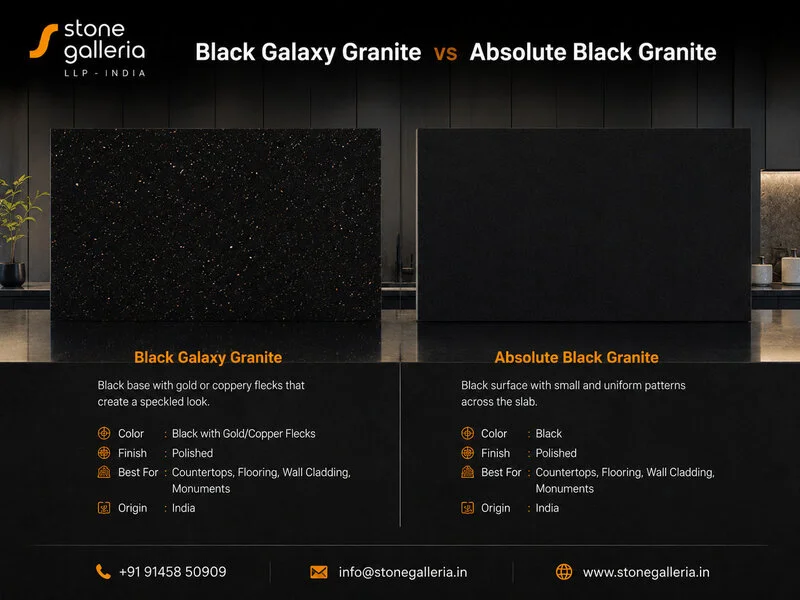
This is not a secret, and it is not a scam. Stone Galleria says so on its own product page: Absolute Black is geologically a fine-grained dolerite, sold worldwide as granite. An independent geologist reaches the same conclusion about Indian Absolute Black. The Government of Andhra Pradesh describes Black Galaxy as a gabbro-norite. Writing in Natural Stone Specialist, Barry Hunt classifies Impala as gabbro, Angola Black as dolerite and Chinese G684 as basalt.
The trade is allowed to name stone this way. The American standard for stone terminology explicitly lets commercial names override the geological ones, and the European naming standard handles it by requiring the rock family to appear alongside the trade name.
Why it matters to you:
the way the stone behaves belongs to the rock, not to the word on the invoice. If you are relying on properties you read about granite, and the slab is dolerite, you are relying on the wrong page.
The three questions to ask a supplier
None of these are difficult, and the answers will tell you a great deal about who you are dealing with.
1. What is the solar reflectance, and who measured it?
There is a standard test for this, and a standard way of turning the result into a single comparable score called the Solar Reflectance Index. A supplier who has had the work done can hand you a figure and name the laboratory. One who says the stone is "cool" or "heat resistant" without a number has not tested it.
We keep black and dark granite in stock in Kishangarh. Ask for a sample. Leave it in the sun. Check it at 3 pm before you commit.
Request a SampleTo see what a real answer looks like, one North American producer publishes third-party calculated figures for its range: a grey granite at 0.44, an Indiana limestone at 0.47, and another granite at 0.29. Note that the last of those is a pale stone that still performs poorly. Colour is a good clue, not a guarantee.
2. Will it meet a green building requirement, if that matters to the project?
The LEED rating system asks paving to reach a solar reflectance of at least 0.33 to count toward its heat-island credit. Set that against the 0.19 measured for dark granite and the answer is plain: a genuinely dark stone will not meet it. Some pale stones do not either, which is why you ask for the figure instead of guessing from the sample.
3. Where exactly is it going?
This is the question that decides most of it, and it is the one least often asked.
Shade beats colour, by a wide margin
The desert study measured the same materials in sun and in shade at the same moment. Shaded surfaces held at 104 to 108 Fahrenheit while sunlit ones ran 36 to 56 degrees hotter. Peak heat arrived between two and four in the afternoon.
Planted shade does something similar. Research modelling urban trees in Florence found tree shade pulling asphalt surface temperature down by 14 to 23 degrees Celsius. The cooling of the air around you is more modest, but the surface effect is large.
No colour choice available to you recovers 36 to 56 degrees. If the area is shaded for most of the afternoon, a dark stone becomes a reasonable proposition. If it bakes from noon onward and people cross it barefoot, no amount of specification fixes that.
ALSO READ | Do Granite Fade and Dull in Sunlight? Prevention and Care
Where dark granite is the right choice
Wherever bare feet and midday sun do not meet, which is a great deal of the building.
- Vertical cladding, which takes far less direct sun than a horizontal surface, and which nobody stands on.
- Interiors, where none of this applies.
- Shaded courtyards, covered walkways and entrance areas under a canopy.
- North-facing elevations and low-traffic feature areas.
The colour is the reason people want these stones, and in those positions there is nothing wrong with having it. The problem is never the stone in itself. It is the stone in open sun underneath a bare foot.
Is Dark Natural Stone a Suitable Choice for Pool Side?
A pool surround is the hardest case, because heat is not the only issue there.
Polished stone is slippery when wet. Laboratory testing across dozens of stones and finishes by the Natural Stone Institute found that polished finishes, on average, fail the common wet-slip benchmark in every stone type tested. One study of a single granite in four finishes measured the polished version at a fraction of the grip of the flamed and brushed versions of the same rock.
So a dark polished slab beside a pool faces two separate difficulties at the same time: the heat it absorbs and the grip it lacks. A texture fixes the second. Nothing fixes the first except shade or a lighter stone.
What about a flamed or brushed finish - does it run cooler?
Nobody has published a measurement that answers this, and anyone who tells you otherwise should be asked for the study.
There is one piece of adjacent evidence. A 2024 study took over 1,600 reflectance readings across 30 carbonate stones and found rougher, less glossy surfaces tended to score better than smooth glossy ones. That is a correlation, on a different family of stone, and the authors themselves ask for it to be verified. It points a direction without settling anything.
Conclusion
Ask for the measured solar reflectance before you ask anything else, and assume a dark stone fails the green-building threshold until a test report says otherwise. Check what the rock actually is, because most black granite is not granite and the properties follow the rock rather than the name. Then decide by position rather than by material: shade removes more heat than any colour choice can.
Dark stone on a wall, in shade, or indoors is a sound and beautiful choice. In open sun where people walk barefoot, the measurements do not support it.
This article was contributed by Mr. Kareem Klisharo, Founder & CEO of Citadel Stone, a US wholesale supplier of white limestone, black basalt and shellstone. He does not quarry or fabricate granite, and every granite figure here is cited to a published source. Reviewed and fact-checked by Stone Galleria before publishing.