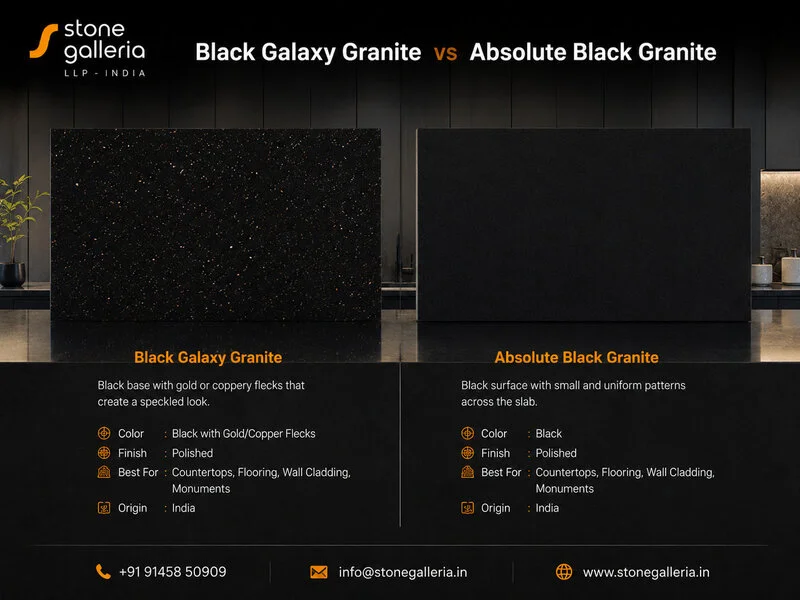
Cuando los clientes llaman o envían correos electrónicos, a menudo nos hacen preguntas sobre temas como acabados, grosor, calidad y precio. Pero una consulta reciente de un cliente en EE. UU. nos hizo pensar en un tema del que no hablamos lo suficiente: el tamaño.
Un gran fabricante con sede en EE. UU. solicitó una cotización para losas cortadas a medida de 111 (longitud) x 42 (ancho/altura) pulgadas con un grosor de 2 cm. En Stone Galleria les presentamos dos cotizaciones basadas en diferentes tecnologías de corte, lo que llevó a una serie de preguntas inesperadas:
- ¿Cuál es la diferencia entre las losas de gangsaw (grandes) y las losas de cutter (verticales o pequeñas)?
- ¿Existe una diferencia de calidad entre las dos?
- ¿Cuánto varía realmente el precio?
- Si las losas verticales son mucho más económicas, deben ser de menor calidad, ¿verdad?
- ¿Por qué las losas de gangsaw son mucho más caras que las losas verticales?
- ¿Qué pasa con las tasas de rotura durante el transporte?
Estas no eran preguntas casuales. Provenían de alguien que trabaja con piedra todos los días.
Eso es lo que nos llevó a escribir este artículo. Si un fabricante experimentado que trabaja con losas día tras día tiene tantas preguntas, debe ser aún más difícil para un propietario común entenderlo todo. Cuando intentamos buscar estas preguntas en Google, las respuestas eran vagas y superficiales. Cuando recurrimos a muchas herramientas populares de IA, obtuvimos respuestas genéricas que no reflejan las realidades de la fábrica.
Así que en este artículo, te daremos el punto de vista de la fábrica: lo que realmente hacemos en el terreno y por qué lo hacemos. Sin florituras de marketing. Sin generalizaciones generadas por IA. Solo lo que vemos, cortamos, empaquetamos y enviamos cada día.
¿Qué son exactamente las losas de gangsaw y verticales?
Antes de entrar en calidad, precio o transporte, comencemos con lo básico: qué significan realmente estos dos términos.
En la industria del granito, escucharás que las losas se refieren por su método de corte o su tamaño. Gangsaw y cutter (también llamado vertical) son los dos términos más comunes, y a menudo se usan indistintamente con "tamaño grande" y "tamaño vertical". Pero los nombres en sí tienen una historia que vale la pena entender, y una vez que sepas a qué se refieren realmente, el resto de esta guía tiene mucho más sentido.
Comencemos con gangsaw.
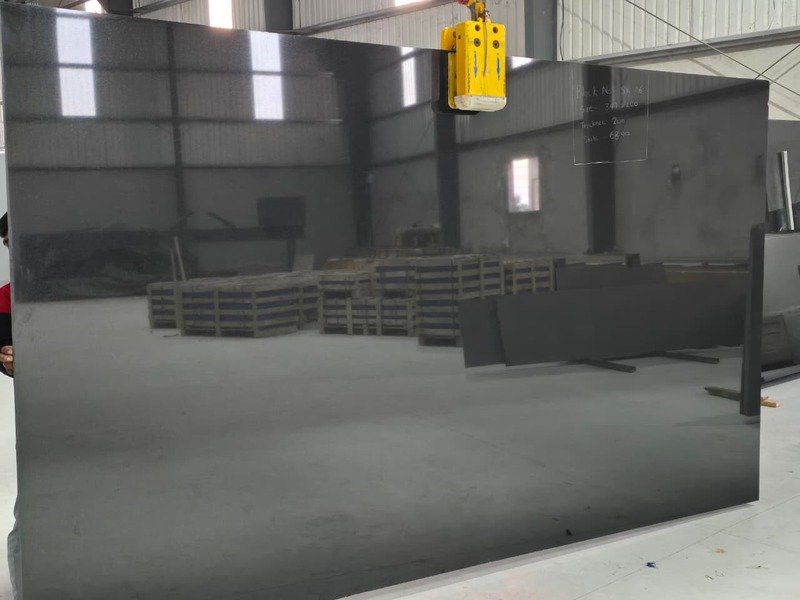
¿Qué significa realmente "Losa de tamaño Gangsaw”?
Un gangsaw es el nombre de una máquina originalmente utilizada para cortar mármol: múltiples hojas que cortan varias losas a la vez, generalmente en formatos grandes. Dado que el mármol generalmente (pero no siempre) viene en tamaños de losas grandes, el término "tamaño de sierra múltiple" se convirtió en un sinónimo de losas de gran formato.
El granito tomó prestado el nombre. Pero aquí está el problema: el granito no puede cortarse realmente en una máquina de sierra múltiple porque es demasiado duro (alto en la escala de Mohs). En su lugar, las losas grandes de granito se cortan utilizando máquinas de hilo múltiple.
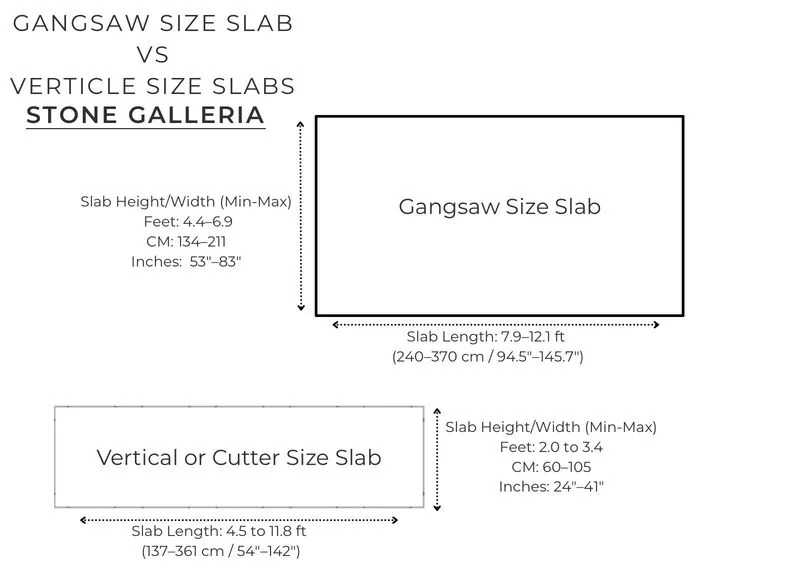
Así que en el granito, "tamaño de sierra múltiple" no describe la máquina, sino el tamaño. Tamaño típico de una losa grande de granito:
- Longitud: 100 a 140 pulgadas
- Altura o Ancho: 60 a 82 pulgadas
- Grosor: 3cm para el mercado de EE.UU. y 2cm para el resto del mundo.
Eso es todo lo que significa. Una categoría de tamaño, no un método de corte.
¿Qué es una losa de tamaño cortadora?
La cortadora es el nombre de una máquina que utiliza hojas de diamante circulares para cortar bloques de granito en losas. Dependiendo de la máquina, puede tener desde 1 hoja hasta 5, 10, 13, 14 o incluso 21 hojas cortando simultáneamente.
A diferencia de una sierra múltiple, la cortadora se utiliza realmente en el granito todos los días. Es el caballo de batalla de la mayoría de las fábricas de granito. Sin embargo, el formato que produce es diferente:
- Longitud: 100 a 140 pulgadas (Puede llegar hasta 156 pulgadas)
- Ancho o Altura: 20 a 42 pulgadas (máximo 43 pulgadas)
- Grosor: 16mm, 18mm, 20mm y 30mm. Se pueden hacer tamaños personalizados fácilmente.
Debido a que la longitud es mucho mayor que el ancho, estas losas tienen un aspecto alto y vertical, por lo que también se les llama losas de tamaño vertical.
La longitud puede ser similar a una sierra múltiple, pero el ancho es donde realmente radica la diferencia: las losas cortadas son estrechas por diseño.
Still have questions about slab sizes?
You're not alone — even seasoned fabricators ask us these questions every week. If something about gangsaw or cutter sizing is unclear for your project, send us a quick note. No quote pressure, just a straight answer from someone on the factory floor.
Ask Us a Question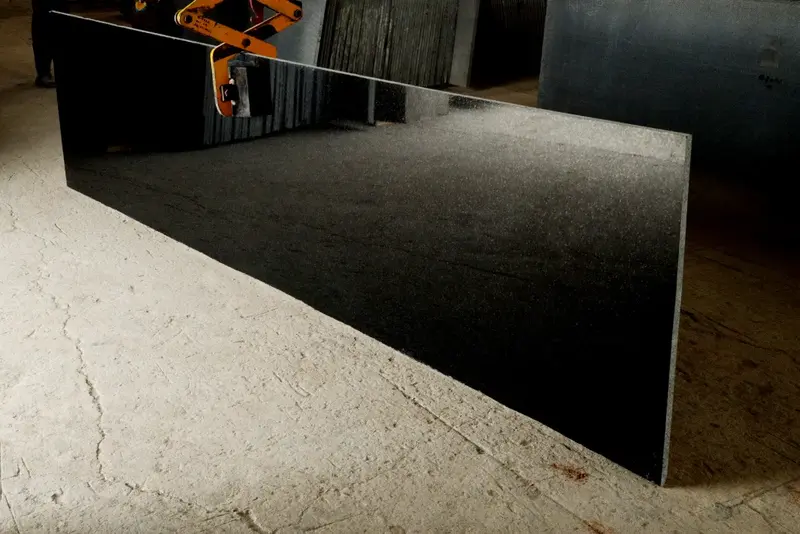
Losas de tamaño cortadora vs. Losas de tamaño sierra múltiple: ¿Cuál es la diferencia en calidad?
Ahora que entiendes cómo se cortan estos dos tipos de losas de granito, surge la verdadera pregunta: ¿hay realmente una diferencia más allá del tamaño?
Para responder a eso, necesitamos retroceder, al material en bruto.
El único material en bruto necesario para producir una losa de granito es un bloque de granito. Todo lo demás en el proceso: agua, hojas, hilos, abrasivos, pulido, son solo consumibles. Y aquí está el punto clave:
Los bloques utilizados para losas de gangsaw y losas de cortadora provienen de la misma cantera.
Ya sea Blue Dunes, Black Galaxy, o cualquier otro granito, los bloques se obtienen de la misma mina, el mismo pozo y la misma veta. Mismo color. Mismo patrón. Misma piedra.
De hecho, es común que recibamos un bloque grande de la mina y lo dividamos en bloques más pequeños según a qué máquina se dirija. Ese mismo bloque podría haber ido a una máquina de multi-hilo para producir una losa de gran formato o a una cortadora para producir losas verticales.
Es literalmente la misma piedra, solo cortada de manera diferente.
¿Entonces no hay ninguna diferencia en absoluto? No del todo.
No estamos diciendo que los dos sean idénticos en todos los aspectos. Hay diferencias, algunas sutiles, otras más notables. Comencemos con las sutiles.
Como mencionamos anteriormente, la verdadera diferencia radica en cómo se cortan.
El multi-hilo es tecnología avanzada y costosa; la mayoría de estas máquinas se importan de países europeos (Italia siendo el líder) o de Brasil.
Las máquinas cortadoras, por otro lado, generalmente se fabrican en India o se importan de China. Son más asequibles y mucho más comunes en los pisos de las fábricas.
Pero la historia más grande es cómo cada máquina corta la piedra, y ahí es donde surgen las verdaderas diferencias.
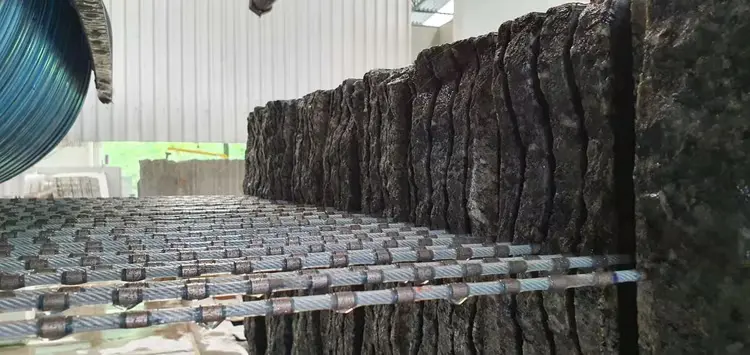
Los hilos descienden verticalmente a través del bloque, todos entrando simultáneamente a lo largo de toda la longitud de la losa. Un movimiento descendente continuo, todos los hilos trabajando a la vez.
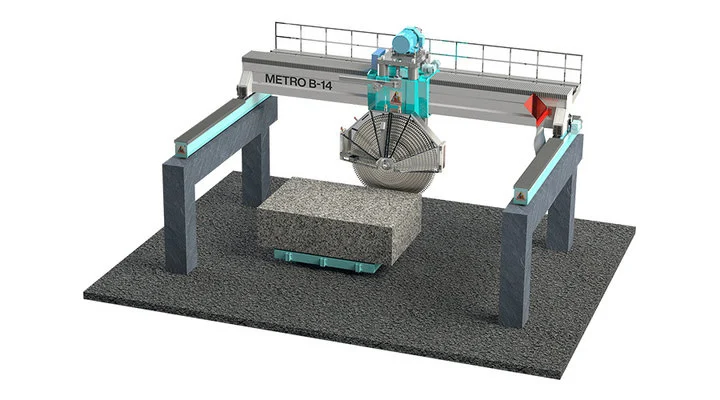
La hoja viaja horizontalmente a lo largo de la longitud del bloque, girando a altas RPM. Entre pasadas, la hoja desciende para cortar la siguiente capa.
De esto surgen dos diferencias reales:
1. Muesca de entrada: solo en losas de cortadora.
Cada pasada comienza con la hoja golpeando la esquina superior del borde de la piedra. Altas RPM más el grosor de la hoja significa que el impacto de entrada en el borde superior es de unos pocos milímetros de profundidad. Ese borde luego no se apoyará plano en la cama de pulido, por lo que el acabado a lo largo de él termina siendo desigual o faltante.
En la práctica, el cliente rara vez lo ve: el borde mellado no se incluye en la medición de losas aleatorias, y se recorta durante la fabricación o en el sitio de instalación para trabajos a medida. Las losas de multi-hilo no tienen este problema.
2. Deformación — y la sabiduría convencional está al revés.
Las losas cortadas típicamente se deforman 1–1.5 mm. Las cuchillas son gruesas y rígidas, por lo que cortan una línea relativamente recta.
Las losas de hilo múltiple se deforman en promedio 1.5–2 mm, y hasta 4–5 mm en piedras más blandas. Los hilos son relativamente delgados y flexibles — se desvían hacia zonas minerales más blandas y se desgastan de manera desigual a medida que avanzan, por lo que siguen el camino de menor resistencia en lugar de una línea recta.
Así que "la sierra múltiple es más plana que la cortadora" a menudo es incorrecto. La cuchilla rígida mantiene su línea mejor que un hilo flexible.
Ahora las Diferencias Percibidas
A menudo escucharás a los compradores decir cosas como “No queremos tamaños de cortadora; son inferiores,” o “Las losas de sierra múltiple tienen mejor color,” o “Las losas grandes tienen mejor patrón”. Estas son percepciones, no hechos. Y aquí está el porqué.
Como acabamos de explicar, el mismo bloque de granito podría haberse cortado en cualquiera de los dos formatos. Pasar un bloque por una máquina cortadora no cambia su color. No cambia su patrón. La piedra es la piedra.
Planning a project? Let's talk specifics.
Now that you know the real differences, the next step is figuring out what makes sense for your project — your application, your budget, your design. Share your requirements and we'll quote both gangsaw and cutter options side by side, so you can decide based on facts, not assumptions.
Request a QuoteEntonces, ¿de dónde viene la percepción? Tamaño y exhibición.
Una losa grande naturalmente muestra mejor el color y el patrón—simplemente hay más superficie para que el ojo capte. Y en la mayoría de los almacenes de piedra, las losas grandes se exhiben a la altura de los ojos, de pie sobre marcos en A, completamente iluminadas.
Las losas cortadas, por otro lado, generalmente se almacenan por debajo del nivel de los ojos, apiladas o inclinadas de maneras que no les hacen justicia visual.
Misma piedra. Diferente presentación. Eso es lo que crea la ilusión de diferencia de calidad.
La Conclusión sobre la Calidad
En una buena fábrica, tanto las losas de sierra múltiple como las de cortadora pasan por el mismo proceso de acabado—mismos abrasivos, misma resina, mismo epoxi, misma malla de fibra. El pulido, el tratamiento y el acabado—todo es idéntico.
¿El resultado final? Funcionalmente la misma calidad de losa — una vez que se recorta la muesca de entrada durante la fabricación, lo que llega al cliente es comparable en acabado, durabilidad y rendimiento.
¿Cuál es la diferencia de precio entre las losas grandes y las losas de tamaño cortadora?
Para entender la brecha de precios, necesitamos volver a dos cosas que ya hemos discutido: materia prima y diferencia percibida, junto con la tecnología de corte.
1. Costo de materia prima
Debido al valor percibido de las losas grandes, y porque las losas de gran formato se exportan mucho, la mayoría de las canteras y minas (no todas) cobran extra por los bloques grandes. Los bloques más pequeños, que van a las máquinas cortadoras, tienen un precio más bajo en la fuente misma.
Así que la diferencia de costo comienza justo en la cantera, antes de que se corte una sola losa.
2. Tecnología de corte
Como se discutió, las máquinas de hilo múltiple son importadas. Son caras de adquirir, caras de mantener y caras de operar. Las máquinas cortadoras, ya sean fabricadas en India o importadas de China, son significativamente más baratas en los tres aspectos.
Esa diferencia de costo se transfiere al precio de la losa.
3. Todo lo demás es mayormente igual.
Con el grosor, acabado, embalaje y transporte siendo los mismos, la diferencia de precio entre una losa de gangsaw y una de cortadora se reduce casi por completo a estos dos factores.
También hay variables más pequeñas: manejo, mano de obra, rendimiento, pero en comparación con el costo de la materia prima y de la máquina, son menores.
Por eso las losas de gangsaw cuestan más. No porque la piedra sea mejor, sino porque el bloque cuesta más y la máquina cuesta más.
En la mayoría de los casos, las losas de gangsaw tienen un precio entre un 30 y un 100% más alto que las losas de cortadora del mismo granito, puramente por estos dos factores.
¿Qué pasa con la rotura y el tránsito: losas grandes vs losas pequeñas
Tanto las losas de gangsaw como las de cortadora pueden viajar de manera segura, ya sea a nivel nacional o internacional, por carretera o por mar. (El transporte aéreo no es factible para ninguna de las dos, simplemente porque la piedra es demasiado pesada.)
El factor clave es cómo están embaladas, no qué tipo son.
Esto es lo que la mayoría de la gente no se da cuenta: si ambos tipos de losas están embalados de la misma manera, no hay absolutamente ninguna diferencia en la rotura. La piedra es la misma, la densidad es la misma y los principios de manejo son los mismos.
Lo que realmente sucede en la práctica es esto: debido a que las losas de gangsaw tienen un precio más alto, generalmente se embalan con más cuidado. Cajas más fuertes, mejor amortiguación, más atención a los detalles. Ese cuidado extra cuesta más y se suma al precio final. Las losas de cortadora a menudo se embalan con un estándar más bajo simplemente porque la piedra en sí cuesta menos y la economía no justifica un mejor embalaje.
Pero eso es una decisión de embalaje, no una limitación de piedra o tamaño. En nuestra experiencia, las roturas ocurren debido a errores de manejo, no al formato de la losa.
Sobre la carga de contenedores y vehículos:
Ya sea un contenedor de envío para exportación o un camión para movimiento doméstico, la capacidad es la misma en pies cuadrados para la misma piedra. La densidad por pie cuadrado no cambia según el tamaño de la losa: una losa de 10 pies y una losa de 7 pies del mismo grosor pesan lo mismo por pie cuadrado. Así que no hay ventaja o desventaja en el costo de tránsito basada solo en el formato.
¿Cuál deberías elegir?
¿Honestamente? No hay uno — y ese es el punto.
Tanto las losas de gangsaw como las de cutter provienen de la misma cantera, el mismo bloque y la misma piedra. Una se corta en una máquina más grande y costosa y viene en un formato más grande. La otra se corta en una máquina más pequeña y común y viene en un formato más estrecho. El acabado, el pulido, la durabilidad—todo es igual.
Las diferencias que hemos cubierto son reales, pero son fácticas, no cualitativas:
- Tamaño: gangsaw es más grande, cutter es más estrecho
- Precio: gangsaw cuesta más debido a la economía de la materia prima y la máquina
- Presentación: Gangsaw se muestra mejor en los patios de piedra simplemente por el tamaño y la exhibición
- Embalaje: las losas de mayor precio generalmente se embalan con más cuidado, pero eso es una elección, no una limitación
Cuál se adapta a tu proyecto depende de tu aplicación, tu presupuesto, tu preferencia de diseño y tu tolerancia a las juntas. Esas son decisiones que solo tú puedes tomar.
En Stone Galleria, trabajamos con ambos tamaños de losas. No estamos aquí para decirte que una es mejor que la otra, porque eso no sería justo. Estamos aquí para presentar los hechos para que puedas decidir qué tiene sentido para tu proyecto.
Misma piedra. Corte diferente. La diferencia no está en el material — está en cómo eliges usarlo.