
 Fact Checked
Let's be honest — when most people think about upgrading with natural stone, the last thing on their mind is the edge profile. You're too busy obsessing over which slab has the best veining, whether to go marble or quartzite, and whether your budget can actually stretch to what you really want.
And that's fair. Natural stone is a big decision. It changes the entire feel of a room the moment it goes in, and it's the kind of thing people walk into your home or space and immediately comment on. There's a reason stone countertop edge profiles have been a defining feature of great interiors since ancient Rome — there's just nothing else like it.
But here's what nobody tells you until you're already deep in the process: the stone itself is only part of what makes a countertop truly stand out. The detail that separates a countertop that looks good from one that looks genuinely thought through — the thing designers, architects, and experienced builders are always quietly looking at — is the edge.
Not the surface. The edge.
Spend five minutes in a stone yard with someone who really knows their stuff and watch where their eyes go first. It's not the slab. It's the profile running along the perimeter — that narrow strip of shaped stone most people never think to ask about until someone points it out. Once you start noticing stone countertop edge profiles, you cannot stop. They say a lot about the people who chose them and the craftsmen who shaped them.
That soft, rounded curve you see finishing so many natural stone countertops has a name — the bullnose edge countertop profile — and at Stone Galleria, it's one of the most consistently requested finishes we work with. Not because it's trendy, but because it works. Across styles, spaces, and budgets, the bullnose edge delivers every single time.
Whether you're a homeowner figuring out what to specify before your fabricator needs an answer, a builder who wants to advise clients with confidence, or an architect or designer looking for a reliable reference — this is everything worth knowing about the bullnose edge countertop profile and why it has earned its place as one of the most enduring choices in natural stone.
What Is a Bullnose Edge on a Countertop?
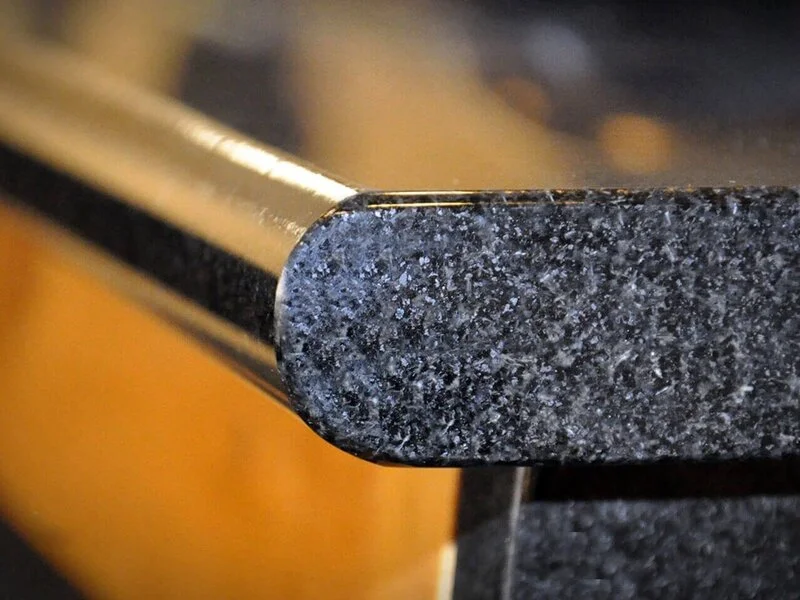
A bullnose edge is a countertop edge profile where the stone is shaped into a smooth, fully rounded curve along its exposed perimeter — no sharp angles, no hard corners, just a clean continuous curve from the top surface to the underside.
It's one of the oldest profiles in natural stone fabrication and still one of the most requested at Stone Galleria — and for good reason. The rounded profile isn't just a design choice, it's a practical one. It resists chipping better than sharp-edged profiles, it's safer in high-traffic spaces, and it works across virtually every stone type, design style, and budget without ever looking out of place.
What most people don't realise is that the bullnose edge isn't a single profile — it's a family of profiles. Full bullnose, half bullnose, demi bullnose, double bullnose, and cove bullnose all share the same rounded DNA but deliver quite different results depending on the stone, the space, and the design intent.
Understanding which one is right for your project is where it gets interesting — and that's exactly what we cover next.
ALSO READ | The Different Types of Granite Edge Profiles
The 5 Types of Bullnose Edge Profiles — And How to Choose Between Them
Not all bullnose edges are the same. The profile you choose affects the way light hits the stone, how thick the countertop appears, and ultimately how the entire space feels. Here's a breakdown of each type and where it works best.
1. Full Bullnose Edge
The full bullnose is the traditional profile — completely rounded on both the top and bottom, creating a smooth, continuous curve from one face to the other. It's the profile most people picture when they hear "bullnose." Works beautifully in family kitchens, bathrooms, and any space where a soft, classic look is the goal. It does make the countertop appear slightly thinner visually, which is worth factoring in for thicker slabs.
2. Half Bullnose Edge
The half bullnose is rounded on top but flat on the bottom edge — a style that emphasises the thickness of the countertop, making it a wonderful choice for highly detailed marble and granite slabs as it can show off a larger cross-section of the stone. A great middle ground between the softness of a full bullnose and the structure of a straight edge.
3. Demi Bullnose Edge
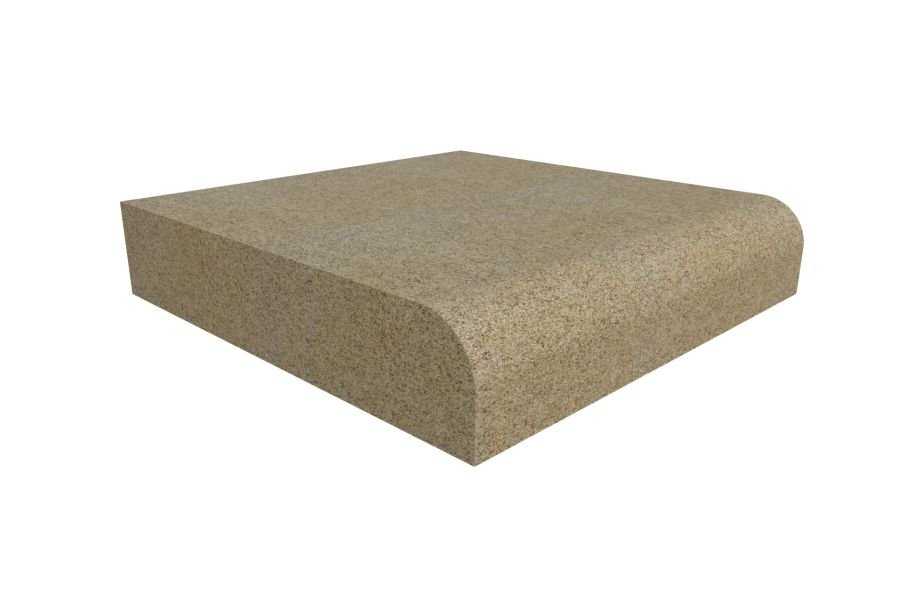
The demi bullnose features a curve that extends further back on the countertop than other rounded edges, with a flat surface on the underside. It is more subtle and gentle — the edge has a more natural, gradual roundness rather than the quicker curve of a full or half bullnose.
It sits at the top of the standard bullnose range before profiles move into premium territory — making it a smart choice for anyone who wants something a little more refined without jumping to a custom edge.
4. Double Bullnose Edge
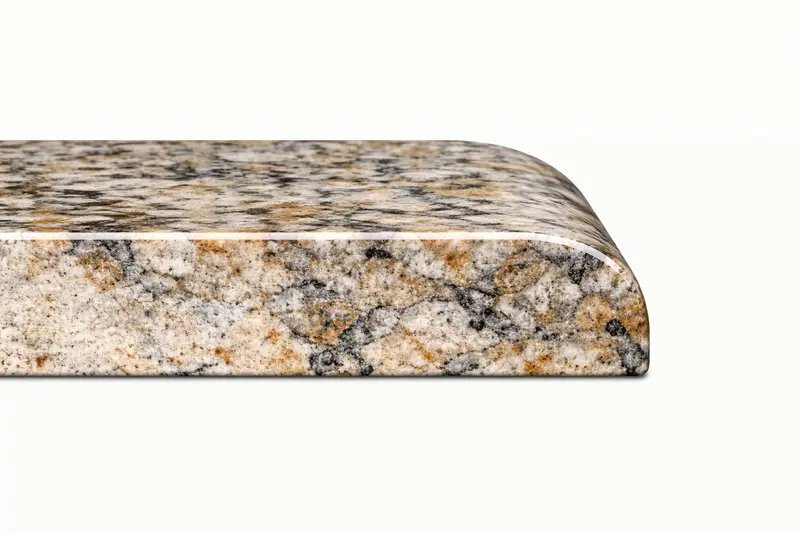
The double bullnose is considered a premium edge — it combines two rounded bullnose curves together, creating a look similar to water gently flowing down smooth stones. It's the most decorative of the bullnose family and works best in larger, more traditional spaces where you want the countertop to make a genuine statement. It also has a very practical benefit — water runs straight off it, protecting your cabinetry below.
5. Cove Bullnose Edge
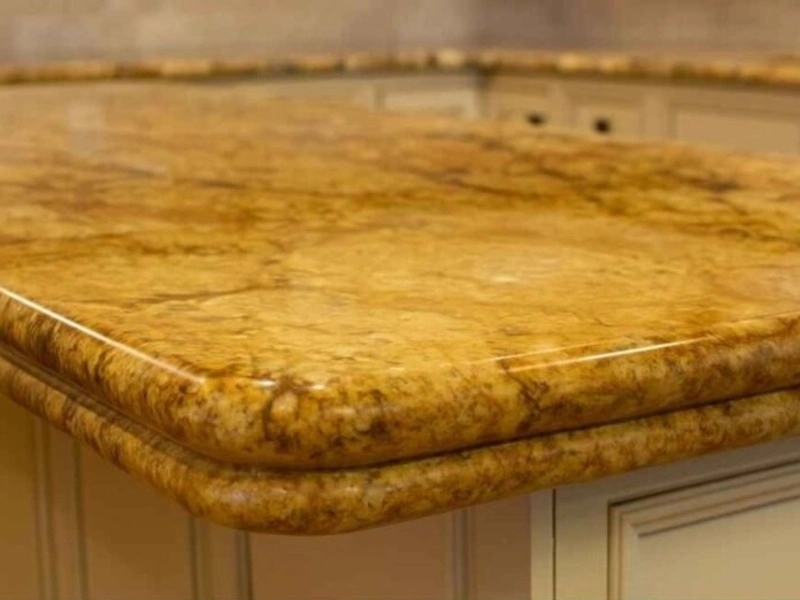
The cove bullnose is where the profile takes a different turn. Rather than curving outward, the edge curves inward — creating a concave, scooped shape along the face of the stone. It's not as streamlined as other bullnose options but can often be customised, and it adds a decorative look that pairs best with a particular design scheme — most effectively in large, open spaces where the detail has room to breathe.
Not sure which bullnose profile suits your stone?
Talk to Our TeamWe work with homeowners, builders and architects daily, getting the right answer takes one conversation.
Full Bullnose vs. Half Bullnose Edge — What's the Difference?
They're both bullnose. They both share that signature rounded curve. But put them side by side on the same slab and they tell a completely different story — and choosing the wrong one for your space is the kind of thing that's hard to unsee once you notice it.
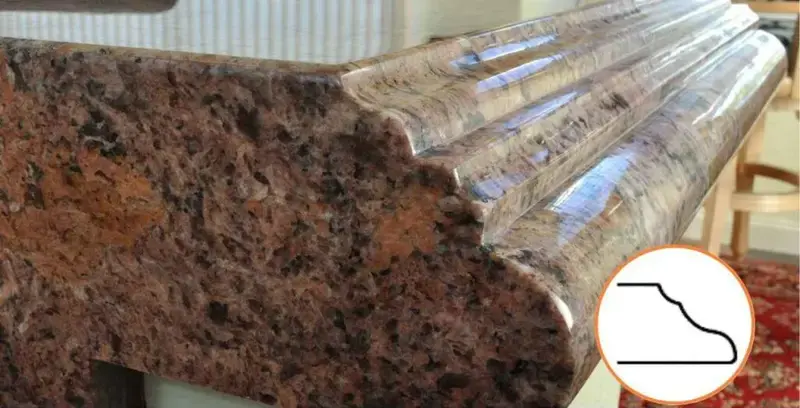
The full bullnose curves completely from the top surface to the bottom in one continuous 180° arc. No flat face, no break in the curve — just a smooth, uninterrupted round from one side to the other. It softens the entire visual weight of the countertop, making it feel approachable and classic. It's the profile that works in family kitchens, bathroom vanities, aged care facilities, hospitality spaces, and anywhere that a clean, timeless finish is the priority.
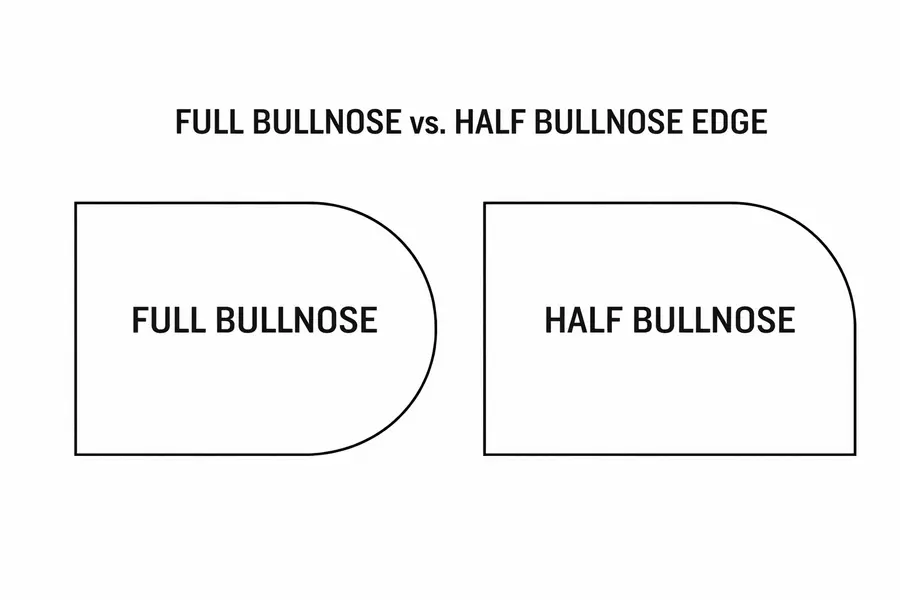
The half bullnose takes a different approach. It rounds off the top edge but leaves the bottom face flat and vertical. What that does is expose more of the stone's full thickness — and if you're working with a beautiful slab, that matters. The half bullnose lets the stone speak for itself. It has a slightly more structured, contemporary feel than the full bullnose while still keeping that softness on the surface where hands and bodies actually make contact.
So how do you choose between them? It comes down to two things — the stone and the space. If you're working with a thicker slab with strong veining or character, the half bullnose gives it more presence. If the design calls for something softer and more understated, or if safety is a priority, the full bullnose is the one. At Stone Galleria, both profiles are among our most specified — and our team can show you exactly how each one looks on your chosen stone before any fabrication begins.
What Stone Types Work Best With a Bullnose Edge?
The short answer is — most of them. The bullnose edge is one of the few profiles that genuinely works across the full spectrum of natural stone. But "works" and "works brilliantly" are two different things, and the stone you're working with does influence how the profile ultimately looks and performs.
Marble
Marble and the bullnose edge have a long history together — and for good reason. The smooth, continuous curve of a bullnose profile complements marble's natural elegance without competing with it. It also does something particularly effective with marble's veining — as the curve wraps around the edge, the veining follows it, creating a fluid, almost organic transition from surface to face that no sharp-edged profile can replicate.
Granite
Granite is dense, hard, and one of the most durable natural stones you can specify. That density means it takes a bullnose profile exceptionally well — the curve polishes up cleanly and holds its shape long-term without chipping or wearing at the edges. It's a practical match as much as an aesthetic one.
Quartzite
Quartzite shares a lot of granite's durability but brings a softer, more varied visual character to the surface. The bullnose edge works particularly well here because it softens what can sometimes be a visually busy stone — giving the eye a clean, calm transition at the perimeter rather than another point of detail.
Travertine
Travertine's warm, earthy tones and natural texture pair beautifully with the bullnose profile. The rounded edge reinforces the stone's organic, aged character — it feels considered and appropriate in a way that sharper profiles simply don't on this material.
Limestone
Limestone is softer than most natural stones, which means edge profile choice matters more here than with harder materials. The bullnose is an ideal choice — its rounded form reduces the risk of chipping at the edge while keeping the stone's quiet, understated character intact.
Bluestone & Sandstone
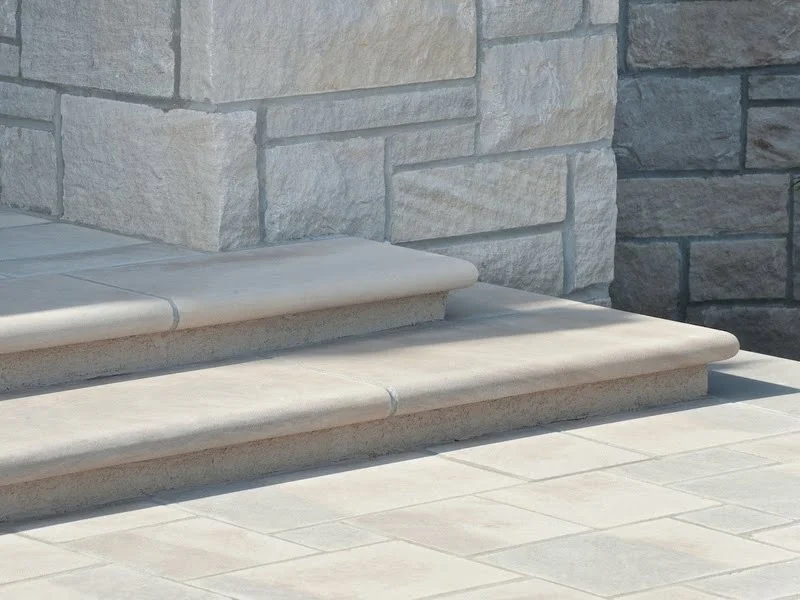
Both materials have a raw, textural quality that suits the bullnose edge well — particularly the half or demi bullnose, which exposes more of the stone's face and lets that natural character show through. Often specified for outdoor applications, commercial spaces, and contemporary architectural projects.
Where Does the Bullnose Edge Work Best? Kitchens, Bathrooms & Beyond
The bullnose edge has stayed relevant for as long as it has for one simple reason — it doesn't belong to a single space or style. It moves comfortably between residential and commercial, traditional and contemporary, understated and high-end. Here's where it consistently delivers its best work.
Kitchen Countertops & Islands
The kitchen is where the bullnose edge earns its reputation most. The rounded profile handles the daily reality of a working kitchen better than most — no sharp corners catching hips as you move past, no hard edges where kids are at counter height, and a surface that's easy to wipe down without debris catching in a profile groove. On a kitchen island especially, where the countertop is exposed on all sides and seen from every angle, the bullnose edge gives a clean, finished look that holds up under constant scrutiny.
Bathroom Vanities
In a bathroom, the bullnose edge brings a quiet refinement that suits the space perfectly. It softens what can otherwise feel like a hard, clinical environment — particularly in smaller bathrooms where every detail is up close. It also performs well around water, with no sharp edges or crevices where moisture can sit and cause long-term damage to the stone or the substrate beneath.
Outdoor Kitchens & Alfresco Areas
Outdoor stone surfaces take a beating — temperature changes, UV exposure, moisture, and heavy use all put pressure on edge profiles. The bullnose edge handles outdoor conditions well precisely because its rounded form has no vulnerable sharp corners to chip or crack under impact. At Stone Galleria, it's one of the most specified profiles for alfresco benchtops and outdoor kitchen builds.
Commercial Bars & Restaurant Counters
In hospitality environments, countertops take serious daily punishment. The bullnose edge is a practical favourite in bars, restaurants, and café fit-outs — the smooth profile is easy to clean, resistant to chipping from glasses and crockery, and presents well in a customer-facing environment where the surface is always on show.
See how a bullnose edge looks on your chosen stone before fabrication begins.
Visit Stone GalleriaOur showroom carries an extensive range of natural stone slabs, see your profile in person before committing to anything.
Reception Desks & Commercial Lobbies
First impressions matter in commercial spaces, and a stone reception desk with a well-executed bullnose edge communicates quality and attention to detail immediately. The profile's clean lines work well in contemporary commercial interiors without ever feeling overdone or out of place.
Retail & Hospitality Fit-Outs
Display counters, service benches, feature walls with stone shelving — the bullnose edge appears throughout retail and hospitality fit-outs because it finishes exposed stone edges cleanly and professionally, regardless of the context or the stone being used.
How Is a Bullnose Edge Made? The Fabrication Process
A bullnose edge might look simple — and that's precisely the point. But achieving that clean, continuous curve on a natural stone countertop takes skill, the right equipment, and an experienced hand. Here's what actually happens between the raw slab and the finished profile sitting in your space.
Step 1: Templating
Before any cutting begins, a precise template of the countertop is taken — either digitally using laser templating technology or physically using a template board. Every measurement, every corner, every cutout for sinks and appliances is captured at this stage. Get the template wrong and everything that follows is wrong. It's the step that separates a professional fabrication from a costly mistake.
Step 2: Cutting the Slab
Once the template is confirmed, the slab is cut to size using a CNC machine or a bridge saw — both water-cooled to protect the stone during cutting. Natural stone is unforgiving at this stage. The cutting needs to be precise, controlled, and done by someone who understands how the specific material behaves under the blade — because marble cuts differently to granite, and granite cuts differently to quartzite.
Step 3: Shaping the Bullnose Profile
This is where the edge takes shape. A series of diamond-tipped profiling wheels — each one progressively finer — grind and shape the stone edge into the bullnose curve. The number of passes and the specific wheels used depend on the profile being cut and the hardness of the stone. A full bullnose requires more material removal than a half bullnose, and a double bullnose requires precision on both curves simultaneously. Rushing this stage is where profiles go wrong — uneven curves, flat spots, and inconsistent radii are all signs of poor fabrication.
Step 4: Polishing
Once the profile is shaped, it moves through a polishing sequence — again using progressively finer abrasive pads until the edge reaches the desired finish. A polished bullnose should reflect light evenly and continuously across the entire curve with no dull patches or visible transitions between grits. On highly veined stones like marble, this stage also determines how well the veining reads across the edge face — a well-polished bullnose on a Calacatta marble is genuinely beautiful. A poorly polished one wastes the stone entirely.
Step 5: Final Inspection & Finishing
Before the countertop leaves the Stone Galleria workshop, every edge is inspected by hand and by eye. The curve is checked for consistency, the polish is checked for uniformity, and the overall finish is assessed against the standard the client expects. It sounds straightforward — but this final check is what separates fabrication that looks good in photos from fabrication that holds up in person, every single day.
The Disadvantages of a Bullnose Edge Profile — What to Know Before You Commit
No edge profile is perfect for every situation — and the bullnose is no exception. It's versatile, timeless, and practical in most contexts, but there are specific scenarios where it's worth pausing and asking whether it's genuinely the right call. Here's an honest look at where the bullnose edge has its limitations.
It Can Make Thick Slabs Look Lighter Than They Are
The full bullnose wraps the entire edge into a curve, which visually reduces the perceived thickness of the countertop. On a 20mm slab that's rarely an issue, but on a 40mm or 50mm premium slab where that thickness is part of the design statement, a full bullnose can work against you. If slab thickness is a selling point of your project, a half bullnose, demi bullnose, or a square profile will showcase it far better.
It Doesn't Suit Every Design Aesthetic
The bullnose edge is inherently soft and rounded — which is exactly what makes it so versatile, but also what limits it in certain contexts. Sharply contemporary interiors, industrial spaces, and minimalist designs with hard geometric lines can feel at odds with a rounded edge profile. In these settings, a straight eased edge or a bevelled profile will almost always read better. Choosing a bullnose here doesn't ruin the space — but it does miss an opportunity to let the design fully commit to its own direction.
The Double Bullnose Can Overpower Smaller Spaces
The double bullnose is a statement profile and it needs room to be one. In a small kitchen, a narrow bathroom vanity, or a compact commercial fit-out, it can feel heavy and decorative in a space that doesn't have the scale to carry it. The rule of thumb — the more elaborate the profile, the larger the space needs to be to absorb it without feeling overwhelmed.
It Requires Quality Fabrication to Look Its Best
A straight edge is forgiving — minor inconsistencies in the cut are hard to detect. A bullnose is not. Because the eye follows the curve continuously from top to bottom, any flat spot, uneven radius, or inconsistency in the polish is immediately visible. A poorly fabricated bullnose on a beautiful slab is genuinely painful to look at. This isn't a reason to avoid the profile — it's a reason to be selective about who fabricates it. At Stone Galleria, every bullnose profile is shaped and polished to a standard that lets the stone do what it's supposed to do.
It Can Trap Water on Outdoor Surfaces if Not Specified Correctly
On outdoor countertops and alfresco benchtops, the full bullnose can occasionally pool water on the underside of the curve if the installation angle isn't accounted for properly. It's a minor and easily managed issue — a slight fall built into the benchtop during installation solves it entirely — but it's worth flagging during the design stage rather than discovering it after the fact.
How Much Does a Bullnose Edge Countertop Cost?
Pricing is the question everyone has and nobody wants to ask out loud — so let's address it properly.
The bullnose edge sits in the mid-range of countertop edge profiles from a cost perspective. It costs more than a basic square or eased edge, but less than ornate profiles like the ogee.
That positioning is actually part of its appeal — you get a profile that looks considered and refined without paying a premium for complexity you may not need.
Pricing varies by region, stone type, profile complexity, and fabricator (retail or factory) — which is why any number published without knowing your specific project should be treated as a rough reference rather than a quote. At Stone Galleria, we price bullnose edge profiles transparently based on your stone selection, slab thickness, and linear meterage — so you know exactly what you're paying for before fabrication begins.
Is the Bullnose Edge Right for Your Project?
For most projects involving natural stone — yes, the bullnose edge is a strong choice. It's one of the most versatile, durable, and timeless profiles available, and it works across residential kitchens, bathrooms, commercial spaces, and outdoor applications without ever looking out of place. The cases where it isn't the right call are the exception, not the rule.
Choose the bullnose edge if:
- You want a timeless profile that won't date
- Safety matters — young children, aged care, or high-traffic commercial spaces
- You're working with marble, granite, quartzite, travertine, or limestone
- The space is residential or hospitality and the design is classic, transitional, or soft contemporary
- You want a profile that's low maintenance and easy to clean
Consider a different profile if:
- The design is sharply industrial or hard-lined minimalist
- You have a thick premium slab and want the thickness to make a statement
- The space is too compact to carry a decorative profile like the double bullnose
Still unsure? That's exactly what the team at Stone Galleria is here for. Bring your brief, your stone selection, or even just a rough idea — and we'll help you land on the right profile before fabrication begins.