
 Fact Checked
In today’s construction and interior projects, natural stone is no longer supplied only as raw slabs. Homeowners, architects, and builders increasingly expect stone to arrive finished, accurate, and ready to install.
Granite and other natural stones are now used for kitchen countertops, table tops, staircases, wall cladding, and custom design elements—where even a small mismatch in size, shape, or finish can affect the final result. Straight cuts are only part of the requirement; modern projects often involve curves, sink cut-outs, edge profiles, symmetry, and precise fitting.
Traditionally, much of this work was done manually at the site. While skilled labor can handle basic cutting, manual methods become time-consuming, expensive, and risky as designs get more detailed or when consistency is required across multiple pieces.
To meet modern quality expectations and design demands, stone processing has gradually moved from on-site manual work to factory-controlled, computer-guided machining. This shift allows stone to be processed with higher accuracy, better repeatability, and far greater control—making complex and previously impractical designs possible.
This is where CNC technology comes into the picture.
Stone-related delays, rework, and wastage most often occur during on-site cutting and adjustment. CNC processing shifts this risk away from the site and delivers stone that is ready to install, helping projects stay on schedule and within budget.
Who this guide is relevant for:
• Architects: Ensuring design intent survives execution
• Builders & project managers: Reducing site dependencies and delays
• Contractors & installers: Cleaner, faster installation with fewer risks
• Homeowners & owners: Fewer surprises, less mess, predictable cost

What Does CNC Mean? (Simple Explanation)
CNC stands for Computer Numerical Control. It refers to machines that are operated using computer programs instead of manual control, allowing stone to be processed with high accuracy and repeatability.
In granite processing, CNC machines follow digital design files (CAD drawings) to cut, shape, and finish stone exactly as specified. The computer controls every movement of the machine—direction, speed, depth, and tool action—removing guesswork from the process.
Most CNC machines used in stone processing operate on 3 to 5 axes, meaning they can move in multiple directions at the same time. This allows the machine to handle not just straight cuts, but also curves, angles, and complex shapes with consistent precision.
Using CNC machines, stone can be:
- Cut to exact sizes
- Profile straight or curved edges
- Drill holes for sinks and fixtures
- Engrave patterns and designs
- Mill edges and polish surfaces
By shifting repetitive and precision-critical work from human hands to programmed control, CNC processing delivers uniform results, often within sub-millimetre tolerances. This reduces human error, minimizes material waste, and produces a cleaner, more professional finish on natural stone.
How CNC Is Used in Granite Processing
In granite processing or for that matter any natural stone or even engineered stone, CNC machines are used to convert raw slabs or block into precise, finished products. Once the design and measurements are set, the entire process is handled by the machine with minimal manual involvement.
Prefabricated granite products are typically produced using CNC processing, allowing stone to be delivered fully finished and ready to install.
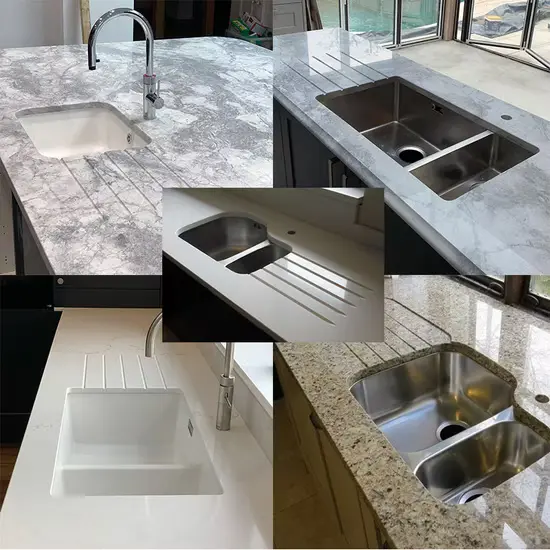
Sink & Fixture Cut-outs
CNC machines are widely used for:
- Sink cut-outs
- Hob and faucet holes
- Drainage grooves
These cut-outs are perfectly aligned and repeatable, which is difficult to achieve manually.
Engraving & Surface Work
CNC technology is also used for:
- Engraving patterns or text
- Decorative grooves
ALSO READ | What Are Prefabricated Granite Countertops? Pros, Cons & Buying Guide
Types of CNC Machines Used for Granite
Different CNC machines are used in granite processing, depending on the type of work, level of precision, and finished look required. Each machine has a specific role in turning raw granite slabs into ready-to-use products.
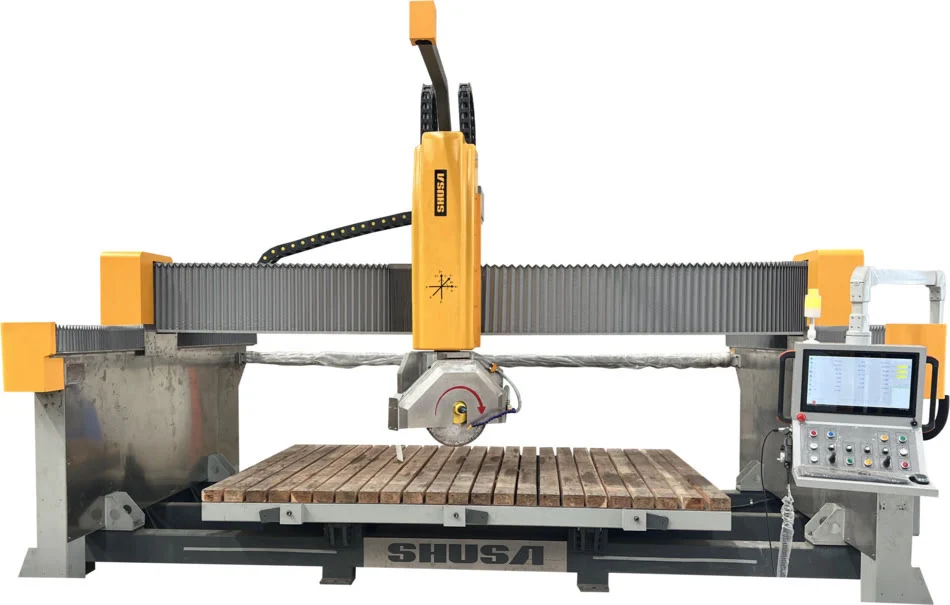
CNC Bridge Saw
Overhead gantry-style machines for straight and angled cuts (0-360°), profiling edges, and slab sizing; ideal for high-volume countertop production with hydraulic tilting tables.
CNC Router and Engraving Machine
Specialized for 2D/3D carvings, lettering, drilling, and intricate patterns on granite surfaces. In granite processing, engraving is usually done on CNC routers by changing the cutting tool. Dedicated CNC engraving machines are used only when very fine detailing or artwork is required.
5-Axis CNC Machine
A more advanced version of CNC equipment.
Used for:
- Complex shapes and angles
- Undermount sink cut-outs
- Sculpted and designer edges
The extra axes allow the tool to move in more directions, making it ideal for expensive and custom work.
CNC vs Manual Granite Cutting
The main difference is accuracy and consistency. Manual granite cutting depends on human skill and can vary from piece to piece, while CNC cutting follows programmed instructions to deliver precise, repeatable, and uniform results with minimal error.
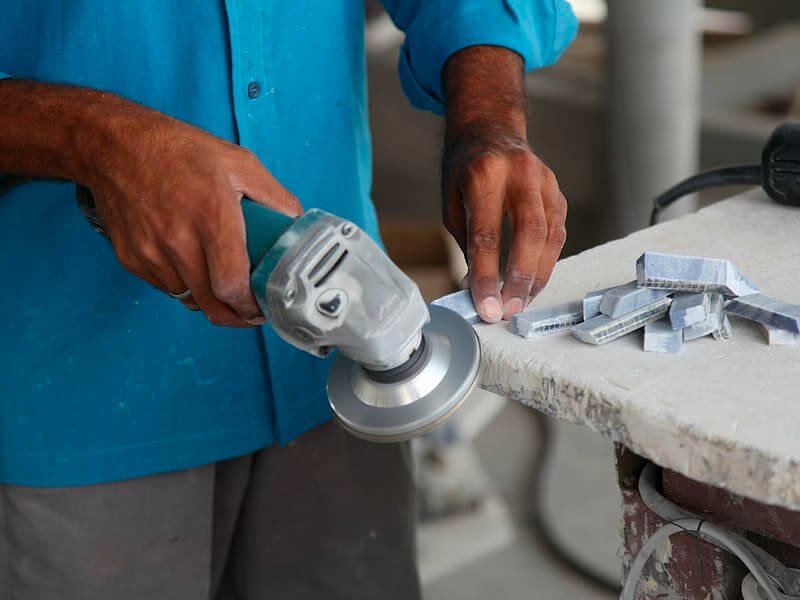
Manual Stone Cutting
Manual cutting depends heavily on human skill and experience. Workers use tools like cutters, grinders, and polishers to shape the stone.
Characteristics
- Accuracy depends on the worker
- Results may vary from piece to piece
- More time-consuming and thus costly.
- On-site cutting needs extra space for slabs, cutting work, and finished granite.
- Higher chance of uneven edges or small errors
- Suitable for simple or low-volume work
- On-site manual cutting means any mistake becomes site waste.
- With on-site cutting, you pay for the full slab, including any possible wastage that may occur at the site.
Manual cutting still exists, but it’s difficult to maintain uniform quality in large or detailed projects.
CNC Cutting
CNC cutting uses computer-programmed instructions to control the machine. Once the design is set, the machine repeats the same process every time.
Characteristics:
- Extremely high accuracy (often below 0.1 mm)
- Same result on every slab, tiles or piece
- Faster processing time
- Clean, smooth edges
- Ideal for complex shapes, sink cut-outs, and bulk orders
- CNC-processed granite comes ready to install, so no workspace is required at the site.
- CNC factory processing shifts the risk of wastage from the site to the factory.
- With factory processing, you pay only for usable, finished material, as any wastage during processing is handled by the factory.
CNC removes guesswork and human error from the process.
| Feature | Manual Cutting | Normal Bridge Cutter | 5-Axis CNC Bridge Cutter |
| Automation | No | Partial | Full |
| Accuracy | Low–Medium | Medium | Very High |
| Complex cuts | Difficult | Limited | Easy |
| Sink cut-outs | Manual | Semi-manual | Automatic |
| Repeatability | Poor | Average | Excellent |
| Finish quality | Variable | Good | Excellent |
| Ideal use | Small jobs | Straight cuts | Bulk and High-end projects |
Where CNC-Processed Stones Are Commonly Used
CNC-processed stones are preferred wherever precision, clean finish, and consistency are important. Because the material is cut and finished in a controlled factory environment, it is widely used in both residential and commercial projects.
Residential Applications
- Kitchen countertops: Perfect sizing, smooth edges, and accurate sink cut-outs make CNC granite ideal for modern kitchens.
- Bathroom vanities: Precise faucet holes, uniform edges, and clean finishes improve both look and functionality.
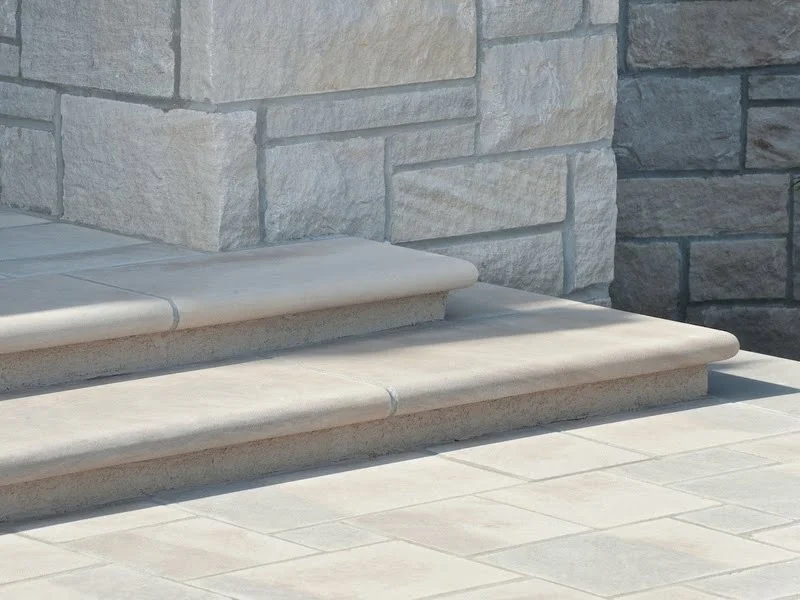
- Staircases & steps: CNC ensures equal thickness, straight edges, and consistent dimensions across all steps.
- Window sills & door frames: Clean lines and exact measurements help achieve a neat architectural finish.
Commercial Applications
- Hotels & hospitality projects: CNC processing ensures uniformity across large quantities, which is essential for premium interiors.
- Shopping malls & offices: Used for flooring, wall cladding, and counters where durability and precision matter.
- Hospitals & institutions: Accurate fitting reduces gaps and improves hygiene and safety.
Custom & Design Projects
- Designer countertops & islands: Complex shapes, curves, and mitre joints are easily achieved with CNC machines.
- Wall cladding & feature walls: CNC allows precise pattern alignment and decorative detailing.
- Engraved stone elements: Logos, text, and design patterns are produced with consistent depth and clarity.
Design-led applications such as fluted wall panels, ribbed surfaces, and textured stone features rely heavily on CNC processing to maintain uniform grooves and clean edges across large areas.
ALSO READ | Why Fluted Granite is Big Trend in Stone Panel Design
Is CNC Granite More Expensive?
At first glance, CNC cutting may look more expensive than manual cutting. However, when you look at the overall project cost, CNC cutting often turns out to be more cost-effective. Here’s whyUpfront Cost vs Actual Cost
| Factor | Manual Cutting | Factory Cutting |
| Cutting cost | Lower | Slightly higher |
| Wastage cost | Borne by customer | Borne by factory |
| Rework risk | High | Very low |
| Labor cost | Higher | Lower |
| Overall value | Uncertain | Predictable |
Manual / On-site cutting:
The cutting charge may seem lower, but you pay for:
- Full slab cost
- Possible wastage at site
- Extra labor and time
- Risk of rework if mistakes happen
CNC factory cutting:
The cutting charge may be higher per unit, but:
- You pay only for usable, finished material
- Wastage during processing is handled by the factory
- Material arrives ready to install
- Chances of rework are minimal
CNC cutting may cost more per cut, but it saves money by reducing wastage, rework, and on-site risks.
How to Identify CNC-Processed Granite
If you’re not from the stone industry, it can be hard to tell whether granite was CNC-processed or cut manually. However, there are a few clear signs that make CNC-processed granite easy to identify.
Clean, Uniform Edges
CNC-processed granite has smooth, consistent edges from start to end. Manual cutting often shows:
- Slight waviness
- Uneven edge thickness
- Minor chips or rough spots
Uniformity is the biggest giveaway of CNC processing.
Perfect Sink & Hob Cut-outs
- Check sink and hob openings carefully.
- CNC cut-outs are precise, symmetrical, and smooth
- Corners are evenly rounded
- Manual cut-outs may look irregular or rough at the edges
Exact Measurements
- CNC machines follow digital designs, so:
- Length and width match drawings exactly
- Multiple pieces fit together perfectly
- Mitre joints align neatly
- Manual work may show small size variations.
In short, accuracy, consistency, and quality of work are the signs of CNC work.
- Accuracy: Precise dimensions, perfect cut-outs, and exact alignment
- Consistency: Identical results across multiple pieces with no variation
- Quality of work: Smooth edges, clean profiles, and a professional finish
If a piece fits perfectly, looks uniform throughout, and needs no correction at the site, it is almost certainly CNC-processed.
How Factory CNC Processing Reduced On-Site Delays in Installation
In traditional workflows, stones often reaches the site as raw or semi-finished slabs, pieces requiring last-minute cutting and slabs that need adjustment to fit actual site conditions.
Installers face multiple challenges at the same time:
- Limited working space
- Dust, noise, and safety restrictions
- Dependence on manual measurements
- Adjustments made under time pressure
- High risk of mistakes that cannot be reversed
Even a small mismatch in size or alignment can stop the entire installation until the issue is fixed or material is replaced. This is where projects start losing time.
With CNC processing, stone is cut, shaped, and finished before it reaches the site. The installer receives material that is already checked, matched, and ready to install.
This changes the installation workflow completely. CNC processing turns stone installation into an assembly task instead of a fabrication task.
Conclusion: Is CNC Worth It?
CNC in granite processing is not just about faster cutting or modern machines. It is about control, predictability, and confidence—from design to final installation. There are benefits for everyone involved:
- Architects: CNC ensures prefabricated pieces match drawings
- Builders: Prefab CNC reduces site work
- Contractors: Installation becomes assembly
- Owners: Less mess, fewer surprises, on time and quality delivery
- Procurement: Predictable, repeatable supply
For simple jobs, manual cutting can still work. But as soon as a project involves precision, repeatability, clean finishes, or custom design, manual methods begin to show their limitations. Small errors become costly, timelines stretch, and results depend heavily on individual skill.
CNC processing shifts this uncertainty into a controlled factory environment, where stone is cut, shaped, and finished according to exact digital designs. This makes complex work possible, improves consistency across multiple pieces, reduces wastage, and delivers ready-to-install material to the site.
While CNC cutting may appear more expensive at first, it often proves to be more economical overall by saving material, time, rework, and on-site effort. More importantly, it delivers results that are accurate, repeatable, and professional.
In simple terms, CNC is worth it when:
- accuracy matters
- design matters
- consistency matters
- and mistakes are not an option
That is why CNC has become a standard part of modern stone processing—and why it continues to shape how stone is used in today’s homes, commercial spaces, and architectural projects.