
 Fact Checked
Natural stone reinforcement is a key part of the stone processing cycle — and block vacuuming plays a critical role in it. This technique often determines whether a stone block will survive the journey from quarry to final installation. It’s not a routine step for every stone; because of the cost involved, it’s mostly used on rare, luxurious, or structurally weak stones that are worth saving.
As global quarry yields of defect-free blocks continue to decline, reinforcement techniques have become essential across the industry — from India to Italy, Brazil to Turkey. Epoxy resin treatments, especially during block cutting, help stabilize cracked or veined blocks and prevent them from breaking during slab production.
Sometimes, the reason is practical. Other times, it’s emotional — the stone is simply too rare or too beautiful to let go.
Take Cristallo Quartzite, for example — named the Stone of the Year 2025. It's already in short supply. Without block vacuuming, it would be nearly impossible to produce slabs large enough for luxury interiors or export-grade projects.
What Is Natural Stone Block Vacuuming?
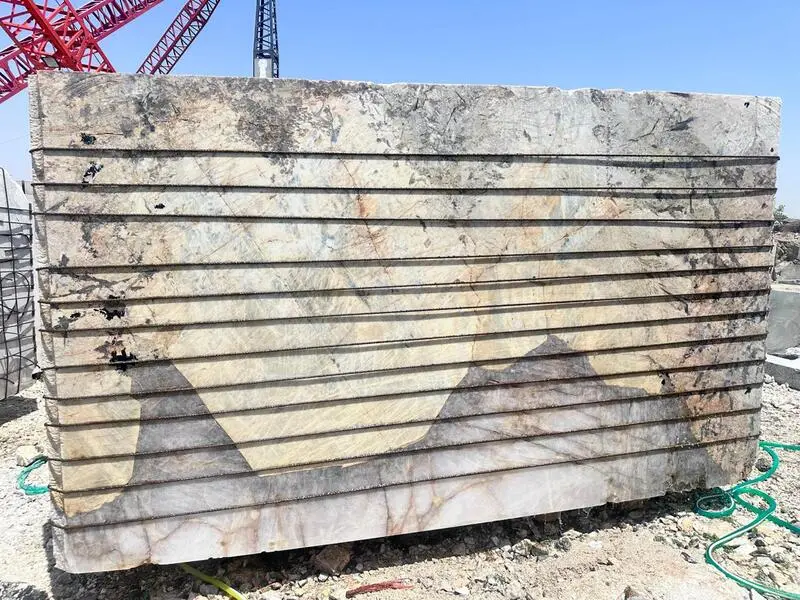
Natural stone block vacuuming is a specialised and technical reinforcement process used in the stone industry to reinforce natural stone blocks (such as quartzite, marble, and granite) by infusing them with epoxy resin or consolidant while the stone is under a vacuum.
It is often referred to as:
- Vacuum resin impregnation
- Vacuum resin treatment
- Resin reinforcement of stone blocks
- Resin injection under vacuum
Block vacuuming differs from resin-treated slabs. While both use resin to cure natural flaws, block vacuuming is performed at the block stage, whereas slab resining is done after the block is cut. Notably, blocks that go through vacuuming still undergo slab resining later.
"Reinforcement of natural stone slabs" is a broader term that includes:
- Resin treatment
- Application of glass fiber mesh or fabric to one side of the slab
Where Is Block Vacuuming Done?
Block vacuuming is performed in:
- Stone Processing Plants: Equipped with vacuum systems and resin injection setups.
- On-Site Quarries or Stone Yards: Especially for fragile or high-value stones that can’t be safely transported without stabilization.
Where Is It Commonly Used?
Widely practiced in countries with advanced stone industries in India, Turkey, Italy & China. Adopted globally for high-quality architectural and commercial stone applications.
Why Do We Even Need This Process?
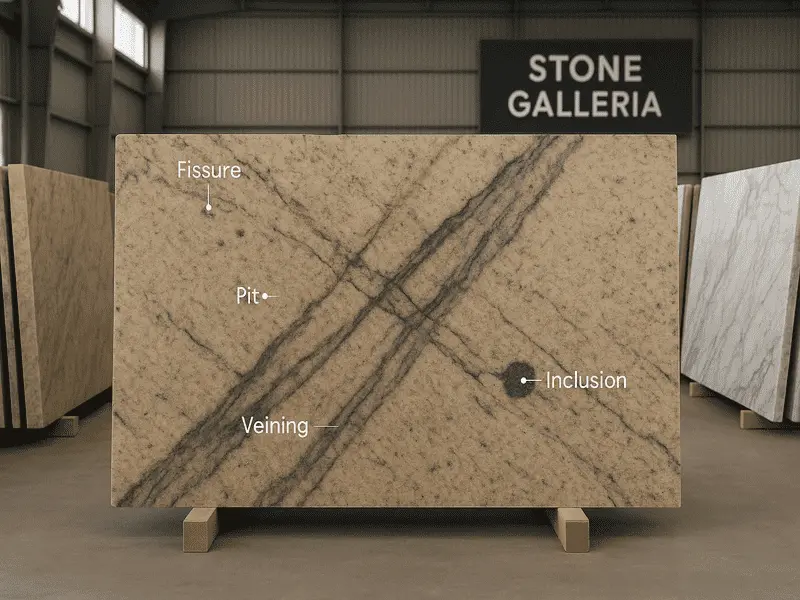
Because most natural stone blocks—especially quartzite, marble, and some granites—don’t come out of the quarry perfect. They often have internal cracks, weak veins, tiny holes, or structural inconsistencies. And with global quarry yields of defect-free blocks getting lower year after year, relying only on naturally sound blocks is no longer practical for large-scale processing.
Block vacuuming exists to make these imperfect but beautiful stones usable. It’s not optional anymore—it’s become a standard practice in the stone industry, both in India and globally.
How Does Block Vacuuming Work? (Step-by-Step Guide)
- Preparation and Cleaning: Block is cleaned and dried to remove dust, moisture, and debris.
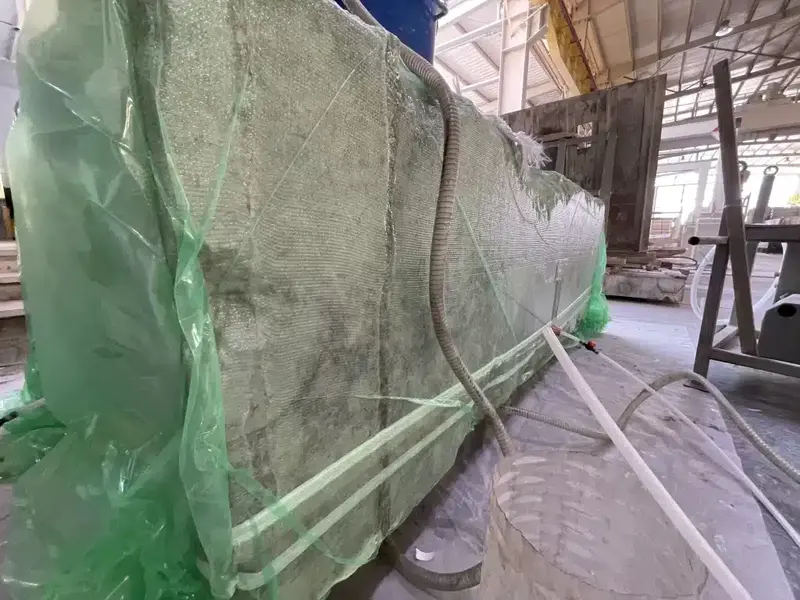
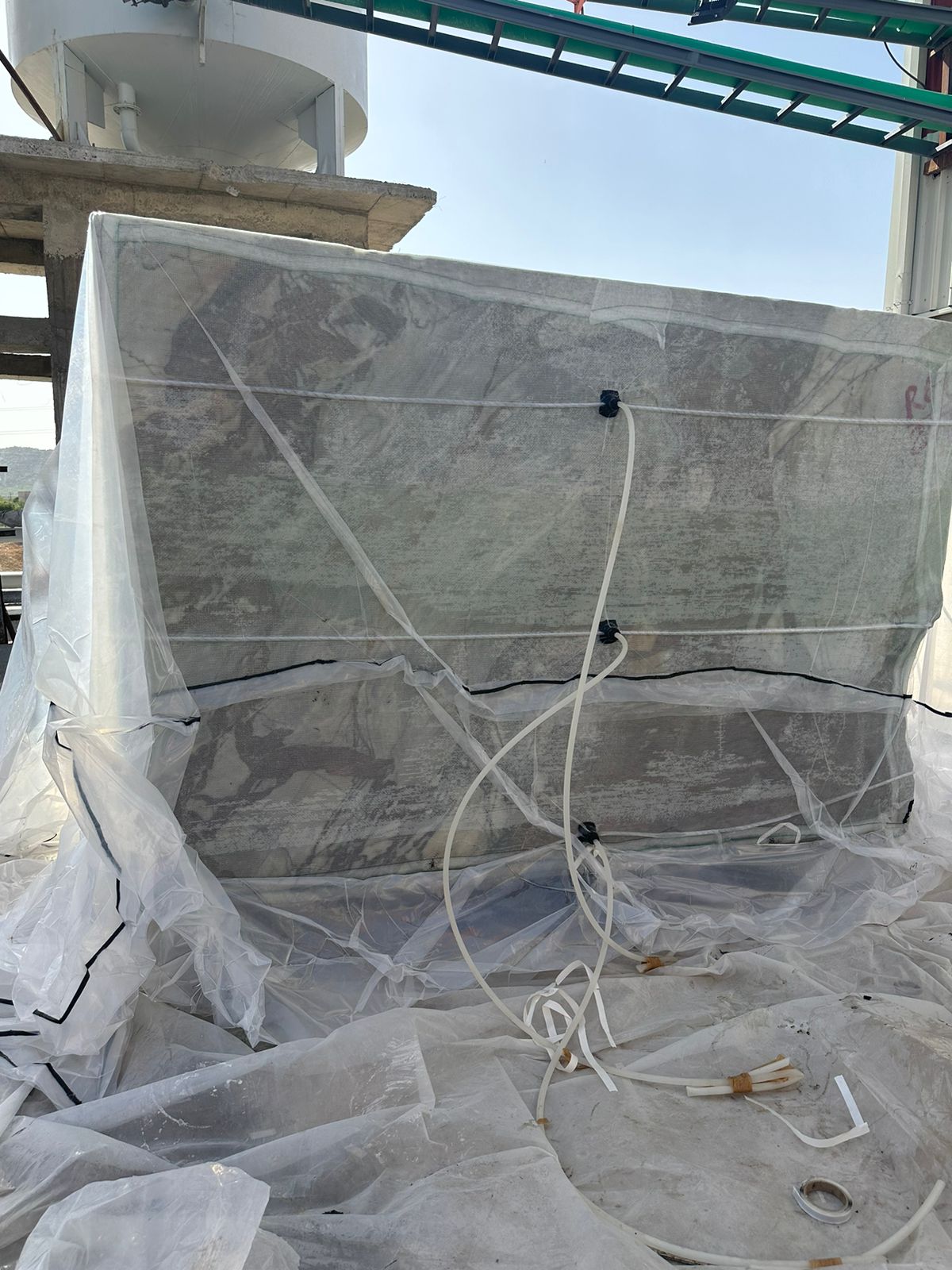
- Vacuum Sealing: The block is enclosed and air is evacuated using vacuum pumps. Removes trapped air and moisture even from microscopic pores.
- Resin Injection: Low-viscosity liquid epoxy is introduced while under vacuum. Resin is drawn deep into the block structure. Glass Fiber Mesh is wrapped around to distribute resin and add strength.
- Curing: Once filled, the resin cures — locking the internal structure and strengthening the entire block from within.
Block vacuuming is so common in India that international epoxy suppliers now conduct the process on-site at quarries — before blocks reach factories.
How Does Resin Reinforcement of Stone Blocks Help?
Block vacuuming plays a crucial role, especially when working with rare, porous, or heavily veined natural stones like quartzite or certain marbles. These stones often come with internal cracks or weak spots that make them risky to process or install.
By reinforcing the entire block before it’s even cut, block vacuuming helps reduce breakage, improve yield, and prepare the stone for demanding applications. This technique is what makes it possible to produce large-format cladding, export-grade slabs, and pieces suited for luxury interiors and countertops or commercial façades—all with better strength, consistency, and appearance.
In short, it turns fragile or flawed blocks into usable material for high-value projects—without losing the stone’s natural beauty.
Reinforcement: Block Vacuuming Vs Resin Treatment of Slabs
Block vacuuming and slab resining may sound similar — and both involve resin — but they happen at different stages. Block vacuuming is done before cutting, at the block level. Slab resining is done after cutting, to fix small cracks or surface pores.
Even when a block is vacuum-treated, the slabs usually still need resining. Knowing how these processes differ helps buyers, engineers, and anyone working with stone make informed choices. There’s also a third but equally important aspect — Reinforcement of Natural Stone Slabs.
Even though block resining and slab resining both fall under the larger umbrella of stone reinforcement, slab reinforcement has its own role. It's done specifically to add strength to individual slabs — especially when the stone is thin, fragile, or has bold veining that makes it more likely to crack or flex during handling, installation, or use.
This type of reinforcement often involves applying resin, mesh, or fabric backing to the slab surface to keep it stable and safe for demanding applications like wall cladding or large countertops.
Table: Comparison of Main Techniques
| Aspect | Block Vacuuming | Resin Treatment of Slabs | Mesh/Fabric Reinforcement |
| Stage | Before block is cut into slabs | After block is cut into slabs | Applied to block before cutting & slab surface after cutting |
| Depth | Deep (entire block) | Penetrates pores/cracks up to several millimeters | Surface-level: mesh sits atop the stone, resin bonds mesh |
| Typical Resin | Two-part epoxy | Penetrating epoxy/UV-cured resin | Epoxy/adhesive for mesh |
| Purpose | Structural block integrity, reduce waste | Fill slab cracks, improve appearance and strength | Prevents slab breakage from bending or mechanical force |
| Common Use Case | Salvage flawed blocks | All commercial slabs (esp. marble, granite, quartzite) | Exotic/fragile/veined stones |
| Material Used | Clear/coloured expoy or polyester resin | Clear/coloured expoy or polyester resin | Fiberglass mesh + resin |
| Aesthetic Impact | None | Enhances surface finish, usually invisible after polish | Invisible from use side; mesh may be visible on back |
| When Required | For Most Quartzite, Marble and some granite | For most marble, quartzite slabs & some granite slabs | For fragile, thin, or highly veined stones; large formats |
ALSO READ | Understanding the Process of Slab Resining of Natural Stones – Marble, Quartzite & Granite
Key Takeaways
- Block vacuuming and resin slab treatment target different stages of stone processing, though both rely on resin to fill natural flaws and increase yield and durability.
- Blocks treated by vacuuming are usually still resin-treated as slabs, due to new cracks or flaws introduced during cutting and handling.
- Reinforcement of slabs is a broad term, including both resin impregnation and application of reinforcing mesh/fabric, each serving a specific function depending on slab quality and intended use.
- Many premium natural stone slabs receive both treatments: resin impregnation and surface mesh reinforcement for optimal quality and safety.
Which Natural Stones Can Be Vacuum Reinforced?
Block vacuuming works well on a wide range of natural stone blocks, especially granite, marble, and quartzite. It’s also used on stones like limestone, travertine, and even some sandstones.
But — not every stone can be reinforced this way. Whether or not block vacuuming will work depends a lot on the stone’s mineral composition and porosity. Some stones respond well to resin infusion; others may be too dense or have a structure that doesn’t allow proper resin absorption.
In short, block vacuuming is a powerful tool — but it’s not a one-size-fits-all solution.
What Are the Risks of Improper Resin Use?
When resin treatment is done right, it makes the stone stronger and more usable. But if it’s done poorly — or with the wrong materials — it can create more problems than it solves.
Here’s what can go wrong:
- Surface issues like dark patches, yellowing over time, or an unnatural plastic-like shine — especially around edges and filled cracks.
- Visual mismatch on low-grade slabs if too much resin is used or applied unevenly. This often leads to patchy or cloudy spots that affect the overall look.
- Yellowing over time is a known issue with polyester or lower-grade resins, especially under sunlight or in outdoor use.
- Chemical reactions between resin and some sealers or cleaners may cause fading, discoloration, or clouding on the surface.
Bottom line? Resin is a helpful tool — but only when used correctly. That’s why it’s important to use high-quality resins and ensure they’re applied by experienced hands.
At Stone Galleria, we don't offer block vacuuming as a service — but we do use it for our own stone blocks before processing. This lets us ensure our slabs meet the performance, finish, and durability standards our clients expect — whether for kitchens, façades, or high-end exports.