What Is The Hardness Of Granite? Understanding Granite Hardness on the Mohs Scale

Mohit Poddar
Author Team Stone Galleria
info Content written and verified by the Stone Galleria Team — combining hands-on stone industry expertise with research-backed insights.
Reviewed By Mohit Poddar Business Development Head — Stone Galleria India
info Expert-verified by Mohit Poddar — with hands-on experience in natural stone sourcing, processing & client consultation.
Published: March 09, 2025 — 17:54 IST Updated: February 24, 2026 — 20:01 IST Read Time: 4 min read 955 Views Fact Checked Fact Checked
Why this article is marked as fact-checked

Every Stone Galleria article/blog goes through a verification process before receiving a fact-checked label. Technical details — including colour variation, density, finishes, production behaviour, and quarry origin — are cross-checked using factory logs, slab inspections, supplier documentation, and real on-site experience. Articles are reviewed by domain experts and updated whenever new or corrected information becomes available.

Takeaways by Stone Galleria AI

Granite ranks between 6 to 7 on the Mohs scale, indicating its hardness and scratch resistance. It is harder than marble, which ranks between 3 to 4, making granite a preferred choice for high-traffic areas. Quartz, an engineered stone, also has a hardness rating around 7, comparable to granite.

  • Granite's hardness makes it suitable for countertops and flooring due to its durability.
  • Marble is softer than granite, with a Mohs scale rating of 3 to 4.
  • Quartz, an engineered stone, has a hardness rating of around 7, similar to granite.

Understanding granite's hardness is essential for selecting materials for durable surfaces.

Curious about granite’s toughness? Join us as we explore the question: what is the hardness of granite? 

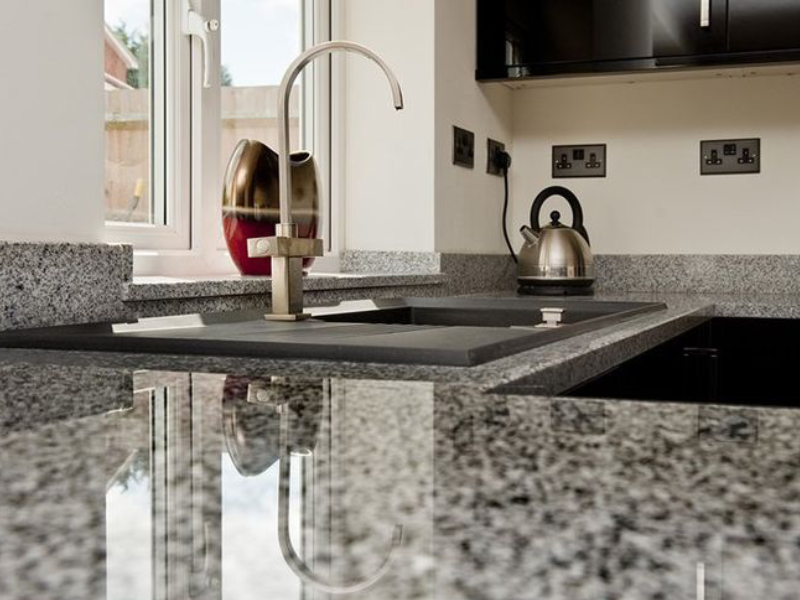
Simply put, granite is quite hard. Think of it like this: if you were to try and scratch it with your fingernail, it would be extremely tough to leave even a mark. It’s much harder than materials like wood or plastic. This hardness is what makes granite such a popular choice for things like kitchen countertops or floors because it can withstand a lot of wear and tear without getting damaged easily. So, in simple terms, granite is pretty tough!

Let’s delve a bit deeper. To put its toughness into perspective, think about trying to scratch it with something like a coin or even a knife. You’d quickly realize that granite puts up a serious fight – it’s incredibly resistant to scratches and damage. It’s like having a shield that protects it from everyday wear and tear. So, when we say granite is tough, we mean it’s tough as nails, built to last, and ready to take on whatever life throws its way!

Given that granite typically ranks between 6 to 7 on the Mohs scale, indicating its considerable hardness and scratch resistance compared to softer minerals, it’s important to understand the factors contributing to these properties. Granite’s density and hardness stem from distinct sources. Hardness is a measure of how tough its constituent minerals, like quartz and feldspar, are, while density refers to how tightly its molecules are packed. Essentially, hardness gauges resistance to scratching, while density reveals the compactness of the material. Thus, while both characteristics play a role in granite’s overall makeup, they represent different aspects of its physical nature.

READ | The Reason for Material Selection: Engineered Stone Vs Natural Stone
What Is The Hardness Of Granite? Understanding Granite Hardness on the Mohs Scale

Is There A Method To Measure The Hardness Of Granite?

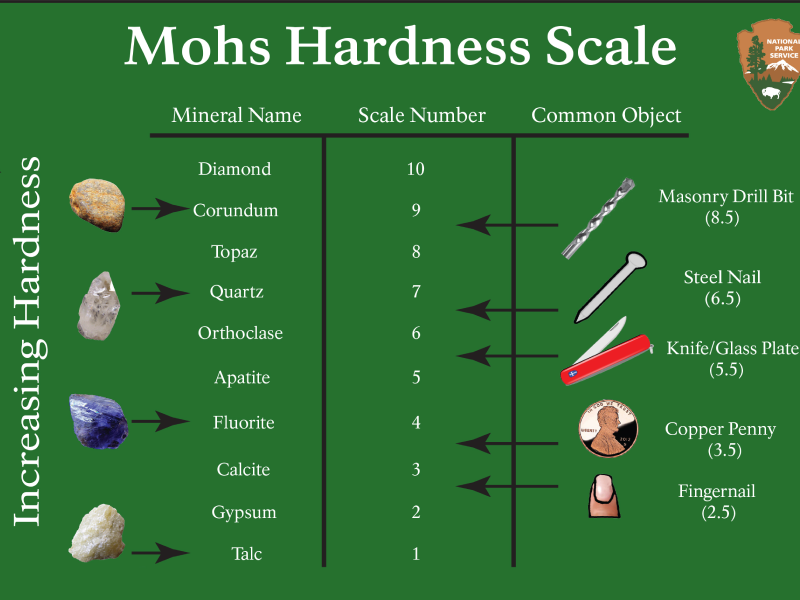
A popular method is used to measure the hardness of minerals, such as granite. The scale is known as the Mohs scale of mineral hardness. Created by Friedrich Mohs in 1812, this scale categorises minerals according to their ability to resist scratches from tougher substances.

Minerals are rated on the Mohs scale based on their hardness level, which ranges from 1 to 10, with 1 being the softest and 10 being the hardest. Granite usually has a Mohs scale rating of 6 to 7, making it quite hard and resistant to scratches when compared to softer minerals, although not as tough as materials like diamond, which scores a 10 on the scale

There isn’t a dedicated scale just for granite, but the Mohs scale can help us gauge how hard granite is in comparison to other minerals.

Now, the question that naturally arises is: which is more harder, granite or marble?
 Mohs Scale

Mohs Scale: Image Courtsey National Park Service

Which Is Harder: Granite Or Marble?

Granite is generally harder than marble. While both granite and marble are natural stones, they have different properties that affect their hardness.

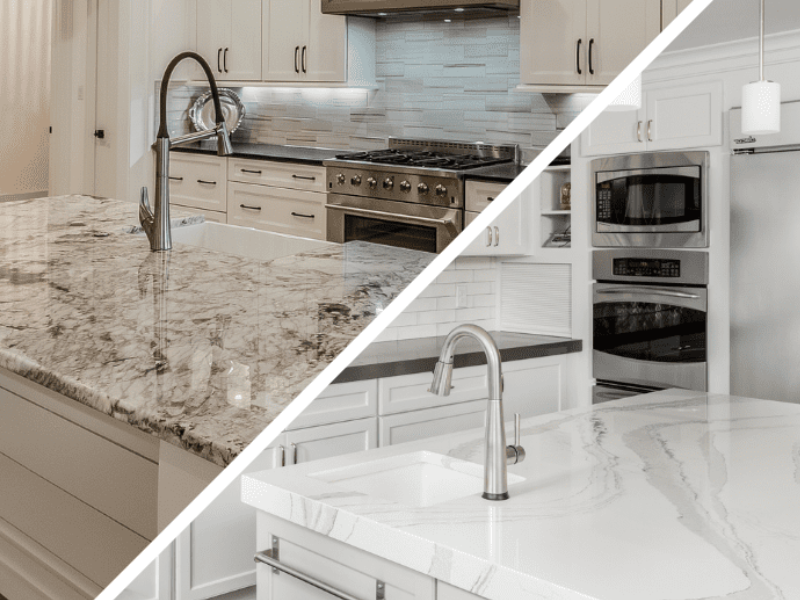
Granite typically ranks between 6 to 7 on the Mohs scale of mineral hardness, making it relatively resistant to scratches and damage. Marble, on the other hand, is softer and typically falls within the range of 3 to 4 on the Mohs scale. This means that granite is more durable and better able to withstand wear and tear compared to marble.

In practical terms, this difference in hardness means that granite is often preferred for high-traffic areas such as kitchen countertops and flooring, where it is more likely to endure heavy use without showing signs of wear. Marble, while still durable and beautiful, may be more prone to scratching and etching in such environments.

Even though marble is not as durable as granite, quartz matches its strength. Quartz is a sought-after alternative to granite, particularly for countertops. Considering that it’s engineered stone compared to natural granite.
 
MarbleVSgranite

What is Harder, Granite Or Quartz?

Granite and quartz are known for their durability and are popular choices for countertops and other surfaces due to their varying hardness levels.

Granite usually has a mineral hardness rating of 6 to 7 on the Mohs scale, which means it is quite hard and can resist scratching.

Quartz is a type of engineered stone created by combining crushed quartz crystals with resin. It usually falls around 7 on the Mohs scale, which puts it in the same hardness range as granite.

ALSO READ | The Reason for Material Selection: Engineered Stone Vs Natural Stone

Practically speaking, granite and quartz are both great options for busy areas because of their strength and ability to resist scratches and damage. Deciding between granite and quartz typically boils down to personal taste, appearance, and desired performance attributes for a specific use.

Now that we know the hardness of granite, marble and quartz. It’s natural to be curious about the hardness of other options, whether they are natural stone or engineered options. Check out our detailed  article comparing different types of stones based on hardness, porosity, stain resistance, and durability.


ASLO READ | Granite vs. Other Materials: A Comprehensive Comparison of Hardness, Porosity, Stain Resistance, and Wear & Tear


Frequently Asked Questions

Quartz and granite share similar hardness, with quartz often slightly surpassing granite. Both fall within the 6 to 7 range on the Mohs scale, making them durable choices for surfaces like countertops.


Quartzite typically ranks higher in hardness compared to granite and marble, generally ranging from 7 to 8 on the Mohs scale.


Quartzite typically ranks higher in hardness compared to granite and marble, generally ranging from 7 to 8 on the Mohs scale.


Granite is generally harder than marble. While granite typically ranks between 6 to 7 on the Mohs scale of mineral hardness, marble falls within the range of 3 to 4.


The strongest stone, in terms of hardness, is diamond. Diamond ranks as the hardest known natural material, scoring a perfect 10 on the Mohs scale of mineral hardness.


The Mohs scale of mineral hardness is a qualitative scale used to rate how easy it is to scratch stone. It gives mineral a score from 1 to 10 based on how easily they can scratch each other. Another mineral that is harder than the one you are trying to scratch can be scratched by the harder mineral. Diamond is the hardest material on the Mohs scale, with a score of 10. Talc is the softest, with a score of 1.


Reviewer: Mohit Poddar

About the Reviewer — Mohit Poddar

Business Development Head · Stone Galleria India

Have Insights to Contribute?

Are you an architect, interior designer, builder, or natural stone professional? If you have insights, corrections, or real-world experience that could enhance this article, we’d love to hear from you.

We occasionally feature expert perspectives and review submissions carefully, publishing only those that align with our focus on natural stone and design.

Write to Us
Trust Icon Why You Can Trust Our Stone Information and Industry Insights
At Stone Galleria, we don’t just write about natural stone — we work with it every day. We source raw blocks from trusted quarry operators, process them in-house, and work closely with contractors, dealers, fabricators, and buyers — both in India and internationally.

As manufacturers, we see what really happens — from selecting raw blocks to finishing slabs — including the challenges, trade-offs, and common questions that arise during actual projects. What we share here is based on real-time production, industry conversations, and our day-to-day factory operations — not just online research.

That’s why the information you’ll find here is practical, experience-based, and shaped by the realities of working with stone — every single day.

Explore Hard and Durable Granite Types

Looking for granite that ranks high on the Mohs scale? Browse our collection of strong and scratch-resistant granites ideal for countertops, floors, and high-traffic zones.

View Granite Collection

Need Help Choosing Granite Based on Hardness or Durability?

Whether you're planning for a kitchen, staircase, or exterior flooring, our team can guide you on the right granite based on strength and Mohs hardness level.

Learn About Granite Grades

Latest Blogs from Stone Galleria

Most Popular Blogs

Cookie Preferences

Strictly necessary (always active)

Analytics cookies

Marketing cookies