
 Fact Checked
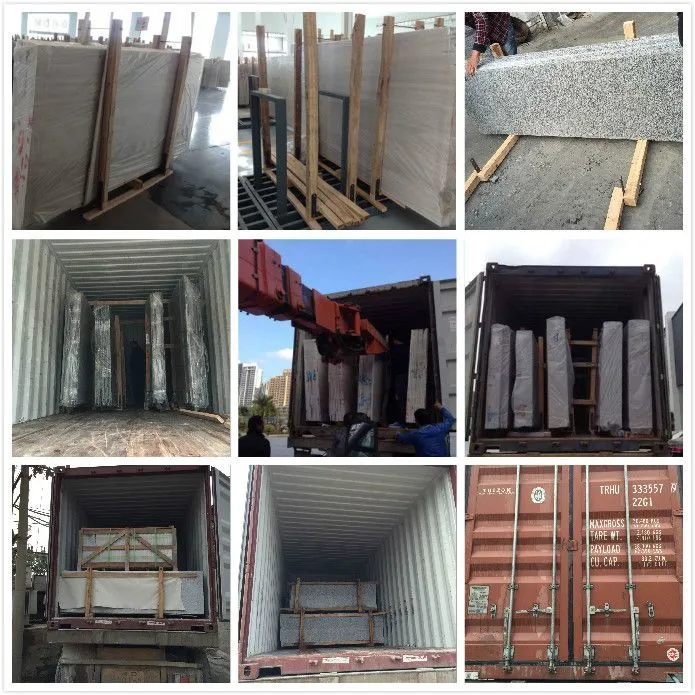
Ever wondered why granite is predominantly shipped in containers? The answer lies in the practical advantages containers provide—from protecting valuable stone slabs during transit to their standardised sizes that simplify handling across ships, trucks, and trains. Shipping granite in containers ensures maximum safety, efficiency, and cost-effectiveness, especially given the weight and fragility of the material.
When it comes to importing or exporting granite—whether slabs, tiles, or raw blocks—the question we hear most often is: how much granite can you fit into a single shipping container? While it would be great to have a simple, ready-made reference table, the truth is there’s no one-size-fits-all answer.
The real key is understanding the factors at play: the size and type of the stone (be it tile, vertical slab, gangsaw slab (large slab), or rough block), the container size, and the regulations at both the port of departure and destination. Once you get familiar with these variables, figuring out container capacity becomes surprisingly straightforward.
That’s where our Granite Shipping Container and Truck Capacity Calculator comes in. This powerful, easy-to-use tool lets you accurately calculate how many slabs, tiles, or blocks you can safely ship per container or truck—accounting for size, density, thickness, packaging, and legal limits.
In this guide, we’ll break down the key considerations to help you confidently estimate how much granite your container can hold—whether slabs (both large and vertical size), tiles (of various sizes and shapes), or even rough blocks—and why shipping containers remain the gold standard for granite transport worldwide.
Key Factors Determining Granite Container Capacity
As I mentioned earlier, there are a few factors that decide how much granite can fit in a container. Let’s go over them briefly before we get into the details.
- Container Size: Most granite is shipped in standard 20-foot containers due to weight limits, though 40-foot containers may be used for lighter or bulkier loads.
- Density of Granite: Granite is very dense and heavy, so containers often reach their weight limit before they are fully volumized.
- Local Regulations: Laws at both the origin and destination—especially maximum road or rail transportable weights—can limit how much a container can be loaded, even before reaching its physical volume limit.
- Product Type & Size: Capacity depends on whether you’re shipping tiles, vertical-sized slabs, gangsaw slabs, custom-made pieces, or rough blocks. Each type has different volumes and weights.
- Slab or Tile Thickness: Thicker slabs mean fewer pieces or square feet per container. For example, 2cm slabs allow more square footage than 3cm or thicker variants.
- Packaging Method & Material: Crating, palletizing, and other packing methods reduce the usable space in a container and add extra weight from the packing materials.
Understanding Shipping Container Sizes and Dimensions
Before we get into how many granite slabs or tiles can actually fit inside a container, it’s essential to first get familiar with the container itself. The size and dimensions of your shipping container are the foundation for calculating its capacity. By understanding exactly what type of container you’re working with, you’ll be able to accurately estimate how much granite you can load. Let’s start by exploring the most common container sizes used in the stone industry, so you’ll have a clear picture of what’s possible for your shipment.
| Specification | 20-Foot Standard Dry Container | 40-Foot Standard Dry Container |
|---|---|---|
| External Length | 6.06 m (20 ft) | 12.19 m (40 ft) |
| External Width | 2.44 m (8 ft) | 2.44 m (8 ft) |
| External Height | 2.59 m (8 ft 6 in) | 2.59 m (8 ft 6 in) |
| Internal Length | 5.90 m (19 ft 4 in) | 12.03 m (39 ft 6 in) |
| Internal Width | 2.35 m (7 ft 9 in) | 2.35 m (7 ft 9 in) |
| Internal Height | 2.39 m (7 ft 10 in) | 2.39 m (7 ft 10 in) |
| Door Opening Width | 2.34 m (7 ft 8 in) | 2.34 m (7 ft 8 in) |
| Door Opening Height | 2.28 m (7 ft 6 in) | 2.28 m (7 ft 6 in) |
| Tare Weight | ~2,300 kg | ~3,750 kg |
| Maximum Payload | ~28,200 kg | ~28,800 kg |
| Volume / Capacity | 33 m³ (1,170 cu ft) | 67 m³ (2,390 cu ft) |
| Sources | ISO 668:2020, ISO 1496-1:2013, Container Handbook | ISO 668:2020, ISO 1496-1:2013, Container Handbook |
These dimensions are approximate standards, but actual values may vary slightly depending on the container manufacturer.
Note: While a 40ft container is twice as long as a 20ft container, it cannot carry twice the amount of granite. This is because the maximum payload for a standard 20ft container is around 28.2 metric tons, whereas a 40ft container’s maximum payload is only slightly higher, at about 28.8 metric tons. Since granite is very dense and heavy, the weight limit—not the container’s volume—ultimately determines how much stone can be shipped.
It’s worth mentioning that there are different sizes available, including specialised container sizes like 10 feet, 45 feet, and high cube containers that have extra height (The height measures 9.6 feet, which is a foot higher than the standard height of 8.6 feet).
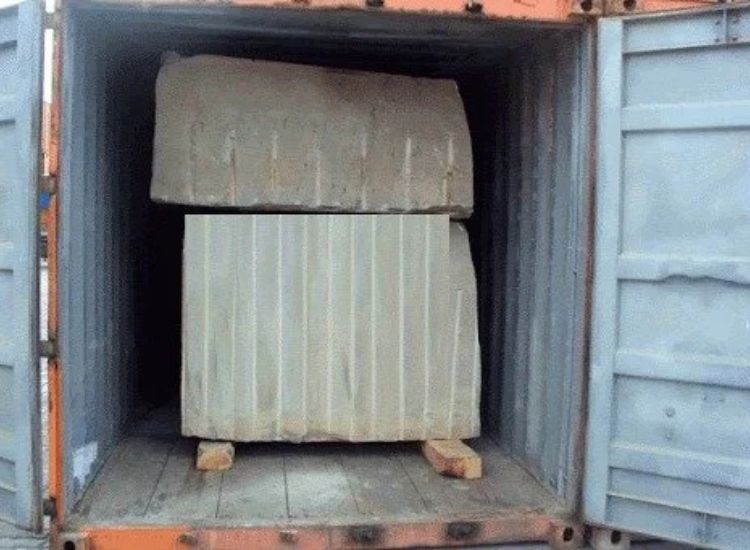
Density of Granite
When it comes to shipping granite, nothing matters more than its density. In fact, the single most important factor in determining how much granite fits in a 20ft or 40ft container isn’t the available space—it’s the total weight. Because granite is dense and heavy, your shipping container will reach its maximum weight allowance long before you even come close to filling it up by volume.
That’s why, at the factory level, we always calculate the maximum payload the container can handle. Then, by dividing that number by the weight of one square foot of granite (based on its density), we can instantly determine the total square footage that fits safely inside.
Total Area (sq ft or sq m) = Maximum Container Payload ÷ Weight per sq ft or sq m of granite
But how do you know the weight of your chosen granite per square foot or meter? Well, the weight depends entirely on its density, which differs according to the type or colour of granite.
We offer two handy tools to help you out. Use our natural stone weight calculator to find the weight of your granite based on its density, or try our natural stone density calculator if you know the weight per square foot and want to determine the granite’s density. Both tools make it easy to get precise numbers for your shipment planning.
No more guesswork—just clear numbers to help you plan your shipment confidently and efficiently!
ALSO READ | Density of Granite: Detailed Exploration
Local Regulation
Local regulations also plays important role how much granite that can loaded in a container. Not all countries allow the maximum permissible payload in shipping containers as defined by container manufacturers or international standards. Each country sets its own regulations governing the maximum weight (gross or payload) a loaded container can carry on its roads, rails, and ports, which can often be lower than the container’s structural maximum.
Key Points:
- Country-Specific Legal Limits: Many countries impose lower legal limits to protect infrastructure like roads and bridges. For example, in the United States, the typical legal road limit for a loaded 20ft container is around 19,900kg (44,000lbs) on a tri-axle chassis—less than the container’s design limit. When it comes to some of European destinations, we consistently load 24 metric tonnes into the container.
- Port and Transit Regulations: Some ports or shipping routes also enforce their own weight restrictions for safety reasons, which can affect how much can actually be loaded.
- Transport Modalities: Rail and barge may allow higher weights than road, so multimodal routes can have different effective limits along the journey.
What’s the Practical Impact?
- When exporting or importing granite or any natural stone, always check the regulations of the destination country and any transit countries.
- Ask your logistics provider about legal weight restrictions—not just the container’s physical capacity—before planning your granite shipments.
In summary, container loading must comply with the lowest applicable legal limit along its shipping and delivery route, not just the container’s structural rating.
ALSO READ | Understanding the Weight of Granite Slabs
How Many Granite Slabs A Shipping Container Can hold?
Once you know the weight of your chosen granite per square foot, calculating how many square feet can fit into a single full container load (FCL) becomes straightforward. This helps you understand the total granite area a container can safely carry based on weight limits.
But then the next big question arises: how many actual granite slabs can fit into that container?
Let’s explore how slab size, thickness along with density affect the number of slabs per shipment, and how this translates to the total area you can transport.
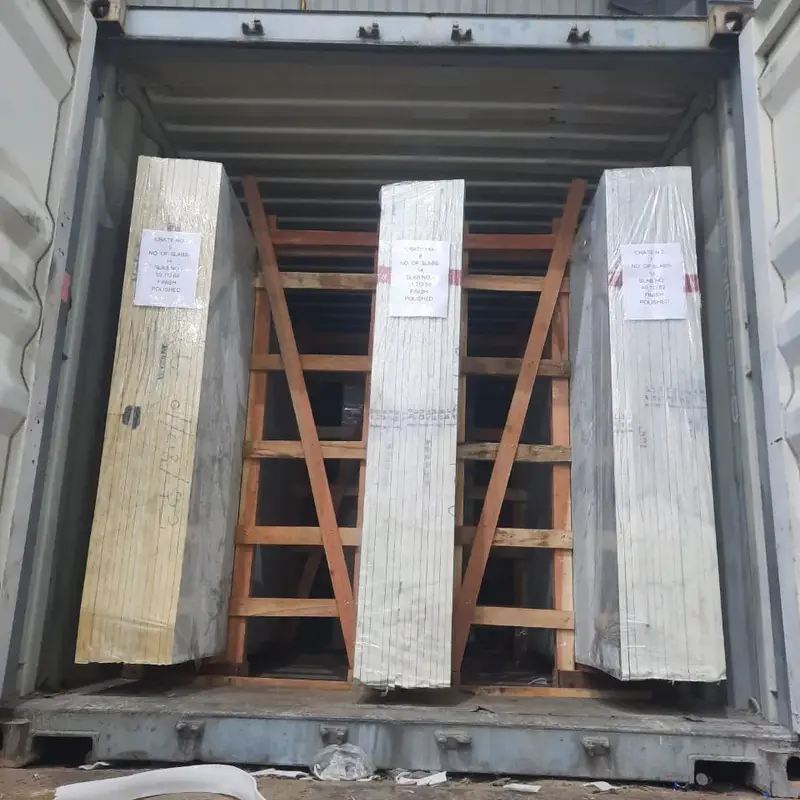
Gangsaw Size Slabs
The number of granite slabs that can fit into a single container depends primarily on the following factors:
- Slab size (length × width)
- Slab thickness (typically 2cm or 3cm)
- Weight of each slab (determined by size and thickness
- Packaging Factor
- Maximum payload (weight limit) allowed by transport regulations for the container
Slab Weight = Area × Thickness × Density
Slab Count = Container Payload ÷ Slab Weight
Typical Full Container Load (FCL) for Granite Large Slabs (20ft Standard Container)
In India, gang saw size slabs typically measure around 330 cm in length (up to 350 cm) and 200 cm in height (up to 220 cm) when produced on modern imported machines such as Breton, Pedrini, or Gaspari.
| Slab size (cm) | Slab Thickness | Area per slab (m² (ft²)) | Weight per slab (kg) | Slab Count | Total area per container (m² (ft²)) |
|---|---|---|---|---|---|
| 330 × 210 | 2 CM | 6.930 (74.6) | 395.0 | 68 | 471.2 (5,072.0) |
| 330 × 210 | 3 CM | 592.5 | 45 | 311.8 (3,356.2) | |
| 300 × 200 | 2 CM | 6.000 (64.6) | 342.0 | 78 | 468.0 (5,037.5) |
| 300 × 200 | 3 CM | 513.0 | 52 | 312.0 (3,358.3) | |
| 270 × 180 | 2 CM | 4.860 (52.3) | 277.0 | 97 | 471.4 (5,074.1) |
| 270 × 180 | 3 CM | 415.5 | 64 | 311.0 (3,347.6) |
Based on - 20-ft container, 27 tons payload, density of 2850 kg/m³ (Conversion used: 1 m² = 10.7639 ft². Values rounded off)
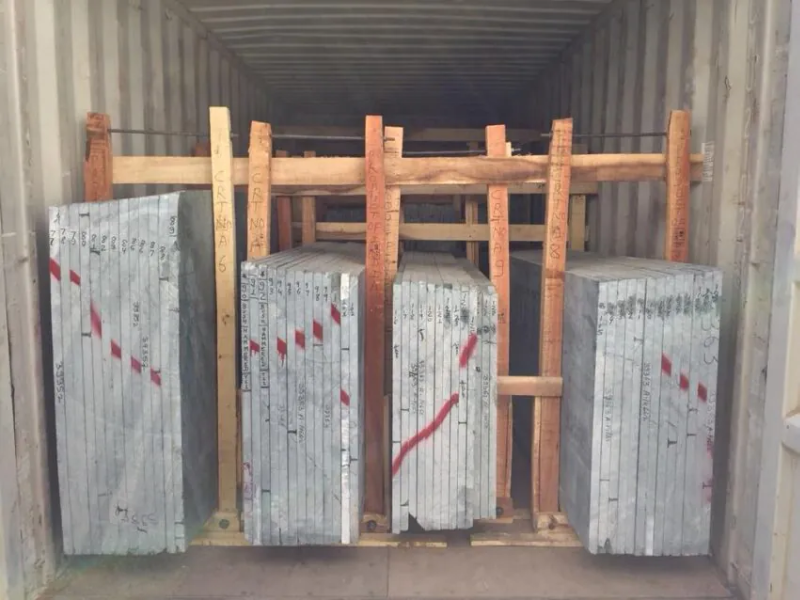
Granite slabs are bundled during loading in containers for efficient transportation, protecting slabs from damage, optimizing space, and streamlining handling processes. This bundling ensures secure transit, ease of identification, and compliance with safety regulations.
- Average Bundles per Container:
- 7 bundles
- 3 at the back and 4 at the front
- Maximum Bundles per 20′ Container:
- 8 bundles
- 4 at the back and 4 at the front
- Minimum Required Bundles per Container:
- 6 bundles
| Criteria | 2 CM Material | 3 CM Material |
| FCL Weight | 28 tonnes | 28 tonnes |
| FCL Bundles | 8 bundles | 6 to 7 bundles |
| Slabs per Bundle | 9 to 11 slabs | 7 slabs (Generally) |
When customers purchase more than 8 bundles, the slabs from the additional bundles are usually distributed among the remaining 8 bundles.
Cutter/Vertical Size Slabs
The same principle applies for cutter-size slabs (also called vertical-size slabs), but with different dimensions and usually more slabs because each piece is smaller than gangsaw (larger) slabs.
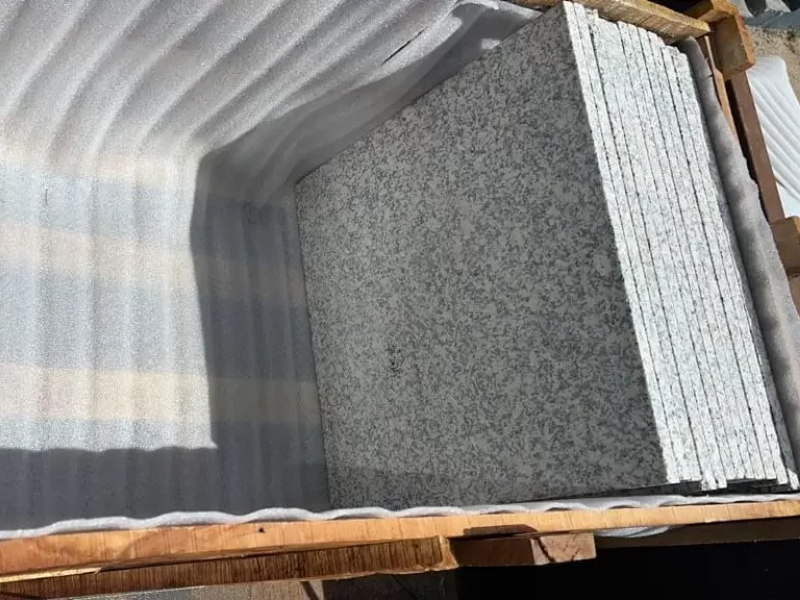
Granite Tile Capacity — 20-ft container, Density 2850 kg/m³
| Tile size | Area per tile (m² (ft²)) | Thickness | Weight per tile (kg) | Max tile count | Total area per container (m² (ft²)) |
|---|---|---|---|---|---|
| 60 × 60 cm | 0.36 (3.88) | 18 mm | 18.47 | 1,461 | 526.0 (5,661.8) |
| 20 mm | 20.52 | 1,315 | 473.4 (5,095.6) | ||
| 30 mm | 30.78 | 877 | 315.7 (3,398.2) | ||
| 30 × 30 cm | 0.09 (0.97) | 18 mm | 4.62 | 5,843 | 525.9 (5,660.8) |
| 20 mm | 5.13 | 5,263 | 473.7 (5,098.9) | ||
| 30 mm | 7.69 | 3,508 | 315.7 (3,398.2) | ||
| 60 × 120 cm | 0.72 (7.75) | 18 mm | 36.94 | 730 | 525.6 (5,657.0) |
| 20 mm | 41.04 | 657 | 473.0 (5,091.3) | ||
| 30 mm | 61.56 | 438 | 315.4 (3,394.9) |
Packaging Method and Material
While the packaging method and material may not have as dramatic an effect as slab size, thickness, or granite density, they still play an important role in determining how much granite you can fit into a shipping container.
Packaging material typically reduces container's available weight for granite by a small but important margin (often 2–5% of total load, slightly more for A-frame packed gangsaw slabs and wooden crates/boxes for tiles). This small reduction ensures slabs and tiles arrive safely, unbroken, and ready for use—protecting your investment.
Always include the weight and volume of your crates, frames, boxes, and pallets in your planning, especially when precise weight limits and tight margins are involved.
Conclusion
You may find plenty of online charts or tables claiming to show exactly how many granite slabs or what area fits in a standard shipping container. However, these numbers are only rough guidelines. The real answer depends on the unique density, size, and thickness of your chosen granite—plus the packaging and transport regulations in your region.
Whenever you see a “one-size-fits-all” number for container capacity, remember: it’s based on a series of assumptions and may not apply to your actual requirements. For the most accurate result, always calculate using your specific granite specifications—or use our tools to customize the answer for your shipment.
Ready to plan your granite shipment with confidence? Use our custom granite calculators to get precise estimates tailored to your specific slab sizes and density. If you need personalized assistance or a detailed quote, don’t hesitate to contact our expert team today—we’re here to help you optimize your shipment for safety, cost, and efficiency.
Start calculating now and take the guesswork out of your next granite export or import!